PURPOSE: The World Health Day is celebrated annually and each year on 7 April to mark the anniversary of the founding of WHO in 1948 and to draw attention on health issues concerning people all over the world. World Health Day is a global campaign, inviting everyone – from global leaders to the public in all countries – to focus on a single health challenge with global impact. By focusing on new and emerging health issues, World Health Day provides an opportunity to start collective action to protect people's health and well-being. The future of health depends on how well we power health through science, research, innovation, data, digital technologies, and partnerships.
FORUM: "Together for Health. Stand with Science." World Health Day 2026. In a world facing complex health threats, WHO calls on everyone to stand with science – by engaging with evidence, facts, and science-based guidance to protect health.Science serves everyone, everywhere. The WHO and its partners work around the clock to generate scientific knowledge on key health priorities from healthy diets to water, sanitation, vaccines and medicines, infections, chronic conditions and mental health; sharing evidence, strengthening countries’ research capacities and systems for more equitable access to health care. Be part of this work, contributing with experiences from you and your community’s perspective, to ensure science-led public health benefits more people to guide future health policies. Our health has improved substantially over the past 100 years – thanks to scientific innovations. The future will be shaped based on how we develop and practice science-led approaches for the health of all – not only humans, but also animals, plants, ecosystems and the entire planet – through the One Health approach. This World Health Day is a call for collective action for Governments and institutions to invest in science-based policies and One Health approaches; For Scientists and researchers to generate and share actionable evidence; For Health workers to champion science and deliver evidence-based care and for Communities to seek trusted information and adopt protective behaviors. As health risks grow more complex and interconnected, standing with science and with each other will be critical to protecting lives and building a healthier, more resilient future for all. Together for health. Stand with science. Follow the conversation with the hashtags #Worldhealthday, #Health, #Together4health, #standwithscience, #sdg3, #7april, #HealthforAll.
EVENTS: This World Health Day 2026, the G7 Presidency of France will host the International One Health Summit. Bringing together Heads of State, global leaders, scientists and community representatives, the Summit will showcase how science and political commitment can drive a new way forward for safeguarding the health of the planet.
Science powers health – One Health. From 5 – 7 April 2026; The One Health Summit plowing by a "one health" intervention will be held in Lyon, France. Progress in public health is built on global solidarity and collaboration. WHO’s ability to connect science with real-life practice in communities and countries around the world is powered through its network of 800 collaborating centres. They are national institutions working in specialized fields such as radiation, influenza, nursing, bioethics, and occupational health, among many others. The organizers' call on everyone to stand up and speak for science sharing their experiences of how facts, evidence and science-based interventions improve their health and the health of their loved ones.
Stand with science – WHO and its collaborating centres in over 80 countries. From 7 to 9 April 2026 will be held the Global Forum of WHO Collaborating Centres entitled '' Collaborating for a healthier future.'' The Forum will highlight how its unique and powerful scientific network drives health impact that touches every person’s life.
Learn how to attend the International One Health Summit and the Global Forum of WHO Collaborating Centres.
STATEMENTS: Read the Statement of the WHO Director-General the World Health Day 2026, April 7th, the Statement of the PAHO Director on World Health Day 2026, April 7th, the Statement of the WHO African Regional office Director on World Health Day 2026, April 7th, the Statement of the WHO WPRO Regional office Director on World Health Day 2026, April 7th, the Statement of the WHO SEARO Regional office Director on World Health Day 2026, April 7th, the Statement of the WHO Europe Regional office Director on World Health Day 2026, April 7th, the Statement of the WHO EMRO Regional office Director on World Health Day 2026, April 7th.
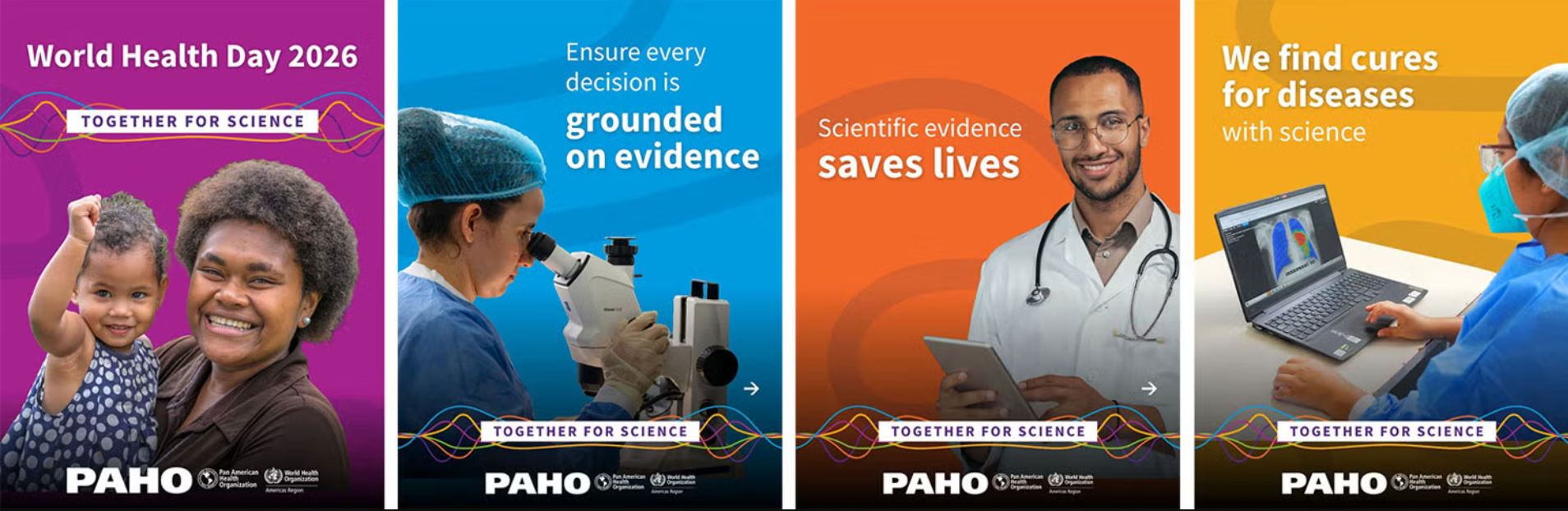


PODCASTS: Together for science. Choose evidence. Trust facts. Support science-led health, for people, animals, and the planet.This year we spotlight scientific achievements, One Health, and the multilateral cooperation needed to turn evidence into action. Listen to the audio-podcasts!
CAMPAIGN MATERIALS: On World Health Day 2026, we unite and mobilize the region under the theme “Together for Science” celebrating the power of scientific collaboration to protect the health of people, animals, plants, and the planet. Explore the Campaign assets and the communication toolkit. Get the communication materials!
ACTIONS FOR GOVERNMENTS
Every law counts; every ministry can and should legislate to realise the right to health across the full range of sectors:
Finance: tax tobacco, sugar, and alcohol.
Agriculture: eliminate trans fats; reduce amount of antimicrobials in the agri-food system by 30-50% by 2030.
Environment: stop fossil fuel subsidies and subsidize or exempt tax of clean energy and fuels such as solar-, hydro- and wind-based electricity.
Justice: prohibit all forms of discrimination.
Transport: build up cycling infrastructure, support pedestrianization.
Labour: Ensure decent work, worker rights and protections, and create fair, equal and gender-responsive working conditions for health and care workers.
Social affairs / social development: Ensure access to social protection (e.g. health-care protection, pensions, unemployment benefits) to reduce households’ vulnerability to poverty and counteract the negative impacts of unexpected life events on income, wealth or health.
Invest in health like your bottom line depends on it: an additional USUSUSUS$ 200–328 billionnbsp;200–328 billion ;200–328 billionnbsp;200–328 billion a year is needed globally to scale up primary health care in low- and middle-income countries (i.e. 3.3% of national forecast GDP).
Deliver on the right to health: make health services available, accessible, acceptable and of good quality for everyone, everywhere.
Be strategic and build from the basics: reorient health systems around primary health care.
Champion transparency and accountability: tackle corruption by strengthening governance and working across sectors.
Involve the general public in health decision-making: ‘social participation’ happens when individuals and communities are meaningfully involved in decision-making around health, e.g. town-hall meetings and citizen assemblies, focus groups and consultations, health councils, representation on steering groups and review boards.
Know the health needs of populations and act on them: collect, analyze, use and monitor data, disaggregate by age, sex, economic status, education level, place of residence, race and ethnicity, and other characteristics and act to correct health inequities.
Safeguard the right to health in war and conflict: protect health infrastructure and health workers and ensure uninterrupted access to health services, in adherence to international humanitarian and human rights law.
PARTNERSHIPS: The new partners who asked to participate in a partnership with the World Health Organization, need to complete the following criteria to review such requests:
The partnership demonstrates a clear added value for public health.
The partnership has a clear goal that concerns a priority area of work for WHO.
Partnerships are guided by the technical norms and standards established by WHO.
The partnership supports national development objectives.
The partnership ensures appropriate and adequate participation of stakeholders.
The roles of partners are clear.
Transaction costs, potential benefits and risks related to a partnership are evaluated.
Pursuit of the public-health goal takes precedence over the special interests of participants.
The partnership has an independent external evaluation and/or self-monitoring mechanism.
ACTIONS FOR INDIVIDUALS
Know your health rights. You have the right to:
safe and quality care, without any discrimination.
privacy and confidentiality of your health information.
information about your treatment and to informed consent.
bodily autonomy and integrity.
Make decisions about your own health.
Protect your right to health as a basic human right.
Everyone should have access to the health services they need when and where they need them, without facing financial hardship. So, if you cannot access healthcare, that’s not right. Here are some ways to take action:Advocate – appeal to political leaders, join health communities demanding action, participate in petitions and discussions.
Organize your community – e.g. at work, church – to agree what needs to change and how.
Promote the right to health as an intrinsic pillar of our broader human rights.
Respecting our right to health means respecting our rights to access safe drinking water, clean air, good nutrition, quality housing, decent working conditions, and freedom from violence and discrimination.
Champion health as a priority.
Get involved with decision-making around health. Examples of how to participate include: town-hall meetings and citizen assemblies, focus groups and consultations, health councils, steering groups and review boards.





WHY WE CELEBRATE THE DAY?
Every year, World Health Day is celebrated on April 7th to mark the anniversary of the founding of WHO in 1948. Each year a theme is selected for World Health Day that highlights a priority area of concern for WHO. The following is a list of suggested activities to disseminate health messages during the World Health Day campaign.
Hold health conferences and fairs and fun runs.
Develop educational materials containing health messages.
Give technical presentations to experts and champions.
Obtain endorsements and enlist the participation of athletes, celebrities and government officials in events.
Develop public service announcements and news releases.
Hold assemblies, conferences, workshops and symposia.
Encourage class or study group discussions.
Assign student assignments (essays, research and book reports).
Create games and contests (posters, writing, photography, essays, exercise and art).
Distribute information from health departments and co-sponsors.
Invite guest speakers to events.
Create plays, music, films and audiovisual presentations.
Conduct diagnostic screenings.
HOW TO GET INVOVED!
It’s time to motivate action to tackle the health challenges of today and tomorrow. In addition, you may consider:
Engage members of parliament, government officials and the media to promote health messages and highlight risk factors causing hypertension
Present the commemorative postage stamps bearing the World Health Day slogan
Organize special lectures and discussions in health forums and syndicates.
Display the communication materials for their placement in waiting rooms in public places, including hospitals and clinics to raise awareness.
Encourage non-governmental organizations to participate in events.
Ask religious leaders in mosques and churches to devote sermons during the first week of April.
Encourage national and local media outlets to promote the World Health Day campaign.
Advocate with the Ministry of Education to allocate at least one hour a day in all primary, preparatory and secondary schools, and medical schools in particular, during the week of World Health Day to talk about Health issues.
ORGANIZERS
The term "partnerships" is used generically to include various organizational structures, relationships and arrangements within and external to WHO for furthering collaboration in order to achieve better health outcomes. The World Health Day is organized by WHO Regional Offices, WHO headquarters; The WHO African Region; The WHO Region of the Americas; The WHO South-East Asia Region; The WHO European Region; The WHO Western Pacific Region; and the U.N. Information Centre. With the partnership of the Alliance for Health Policy and System Research (AHPSR); The European Observatory on Health Systems and Policies; The Partnership for Maternal, Newborn and Child Health (PMNCH); The Unitaid. With the collaboration of the Joint United Nations Programme on HIV/AIDS (UNAIDS); The United Nations International Computing Centre (UNICC); the WHO Framework Convention on Tobacco Control (FCTC); The Special Programme on Research and Training in Tropical Diseases (TDR); The Special Programme of Research, Development and Research Training in Human Reproduction (HRP); the Global Polio Eradication Initiative (GPEI); The Global Alliance for HIV, Tuberculosis and Malaria; The Gavi alliance.
With the Participation of the International and Regional Community Health Organizations, hospitals, clinics, dispensaries, healthcare centers, with the assistance of practicians and surgeons, nurses, healthworkers, academics and individuals.

Make a donation
Contribute to the WHO Foundation which supports WHO’s work to protect mothers and babies in countries around the world. The WHO review showed that the success of campaigns depends on a number of additional factors, including: relevance of the subject and prioritization of the subject and the campaign by countries; agreement by key stakeholders on clear goals and objectives; having effective planning and project management mechanisms in place; and sufficient financial and human resources being allocated to campaign planning, management and evaluation.