PURPOSE: The United Nations General Assembly has designated December 11th, from 2003 onwards, as International Mountain Day. The day aims to create awareness about the importance of mountains to life, to highlight the opportunities and constraints in mountain development and to build partnerships that will bring positive change to the world’s mountains and highlands. The Mountains cover around 27% of the Earth’s land surface and host about half of the world’s biodiversity hotspots. As the water towers of the world, they supply freshwater to an estimated half of humanity. Mountains are home to an extraordinary range of plants and animals, and to many culturally diverse communities with different languages and traditions. From climate regulation and water provisioning services, to soil maintenance and conservation, mountains are key to our lives and livelihoods. Yet mountains are suffering from the impacts of climate change and unsustainable development, escalating risks for people and the planet. Climate change threatens the flow of water, and fast-rising temperatures are forcing mountain species and the people that depend on these ecosystems to adapt or migrate. Steep slopes mean the clearing of forest for farming, settlements or infrastructure can cause soil erosion as well as the loss of habitat. Erosion and pollution harm the quality of water flowing downstream. According to the Intergovernmental Panel on Climate Change, up to 84% of endemic mountain species are at risk of extinction, while populations of a range of other montane plant and animal species are projected to decline and face extinction. The recent biodiversity agreement of the 2022 United Nations Biodiversity Conference – which pledges to protect 30% of the Earth’s lands, oceans, coastal areas and inland waters by 2030 – provides an impetus to revive and protect mountain landscapes. Increasing climate variability, coupled with a lack of investment in mountain agriculture and rural development, has often pushed men to migrate elsewhere in search of alternative livelihoods. Women have therefore taken on many tasks formerly done by men, yet mountain women are often invisible due to a lack of decision-making power and unequal access to resources. On 16 December 2021, to promote action for mountains, the General Assembly proclaimed 2022 as the International Year of Sustainable Mountain Development at the proposal of the Kyrgyz Government. The Roadmap to observe 2025 as International year of Glaciers and World Day for Glaciers were adopted by a United Nations General Assembly resolution inviting UNESCO and WMO, in cooperation with UN Member States and relevant organizations of the United Nations system, to facilitate their implementation.
FORUM: “Glaciers matter for water, food and livelihoods in mountains and beyond” International Mountain Day 2025. The theme will highlight the importance of glacier preservation for agriculture, water security and the livelihoods of vulnerable mountain communities. Glaciers, vast reserves of ice and snow found across the planet, are far more than frozen landscapes - they are lifelines for ecosystems and communities. Yet, these critical components of the Earth's systems are undergoing rapid and alarming transformations with profound consequences for us all. Glaciers and ice sheets hold around 70 percent of the world's freshwater. Their accelerated melting represents not only an environmental crisis, but a humanitarian one, threatening agriculture, clean energy, water security and billions of peoples’ lives. Their retreat, driven by rising global temperatures, is a stark indicator of the climate crisis. Melting glaciers and thawing permafrost increase risks such as floods, glacier lake outburst floods, landslides or enhanced erosion and sediment, endangering downstream populations and critical infrastructure. Economically, sectors like agriculture, hydropower, mountain tourism and transportation feel the strain of glacier changes. For many Indigenous Peoples, glaciers are sacred, and their disappearance signifies a loss of identity and connection to nature. The United Nations General Assembly proclaimed 2025 as the International Year of Glaciers’ Preservation to raise awareness on the vital role glaciers, snow and ice play in the climate system and water cycle, as well as the far-reaching impacts of rapid glacial melt. It aims to promote global collaboration, strengthen scientific research, and promote policies and actions to protect glaciers and cryospheric systems. Follow the conversations with the hashtags:#MountainDay, #ReadingMountains, #11December, #MountainsMatter, #mountainecosystem, #ecosystemservice, #InternationalMountainDay.
EVENTS: On thursday, December 11th, 2025, from 10.00 - 16.30 CET at the Atrium, FAO Headquarters, Rome, Italy; Join the Food and Agriculture Organization of the United Nations (FAO) and the Mountain Partnership Secretariat event entitled ’’Glaciers matter for food, water and livelihoods in mountains and beyond’’ in the FAO atrium to celebrate International Mountain Day 2025. The event will feature prominent speakers and a dynamic set of activities that bring together global leaders, experts, mountain community representatives and change makers. The programme opens with a video message from FAO Director-General QU Dongyu, followed by statements from distinguished speakers and mountain champions, the Mountain Future Award ceremony and a mountain youth panel discussion.
From 11.35 to 15.00 (CET), the celebration continues in FAO’s Atrium with the “From glaciers to cones” tasting experience, where visitors can enjoy artisanal ice cream and mountain products from Slow Food producers in Italy. The Atrium will also host the interactive exhibition “On the Trail of the Glaciers” from 8 to 19 December. On display will be a striking visual exploration of glacier retreat around the world through comparative photographs and videos taken across time.
Provisional programme.
10.00-11.35 CET | High-level event, Sheikh Zayed Centre,
High-level segment presented by Zhimin Wu, Director, Forestry Division, FAO (moderator)
High-level statements
QU Dongyu, Director-General, FAO (video message)
H.E. Dinara Kemelova, Special Representative of the President of the Kyrgyz Republic on mountain regions development
H.E. Krisztina Bende, Ambassador, Permanent Representative of the Swiss Confederation to FAO
Filippo Lonardo, Deputy Permanent Representative of the Republic of Italy to FAO
José Eduardo González Mantilla, Deputy Permanent Representative of Peru to the International Organizations based in Rome.
Mountain Future Award 2025 ceremony.
Giorgio Grussu, Project Coordinator, Mountain Partnership Secretariat (MPS), FAO (moderator)
H.E. Jonibek Hikmat, Permanent Representative of the Republic of Tajikistan to the United Nations (TBC), presents the award to the three winners together with the sponsors Forte di Bard, Slow Food Italia and Sapienza University of Rome – Polo Museale
H.E. Taalai Bazarbaev, Ambassador, Permanent Representative of the Kyrgyz Republic to FAO, presents special award prize
Mountain Youth voices: Stories from the Glaciers - Stefania Corrado, Communication and Advocacy Specialist, MPS, FAO (moderator)
Panel discussion featuring Mountain Youth Hub representatives:
Jigchen Norbu, Bhutan
Sambat Ranabhat, Nepal
Mari Khruleva, Russian Federation
Closing remarks Ludovica Tancredi Martinelli, Chair of the Mountain Partnership Steering Committee, Ministry of Foreign Affairs and International Cooperation of Italy.
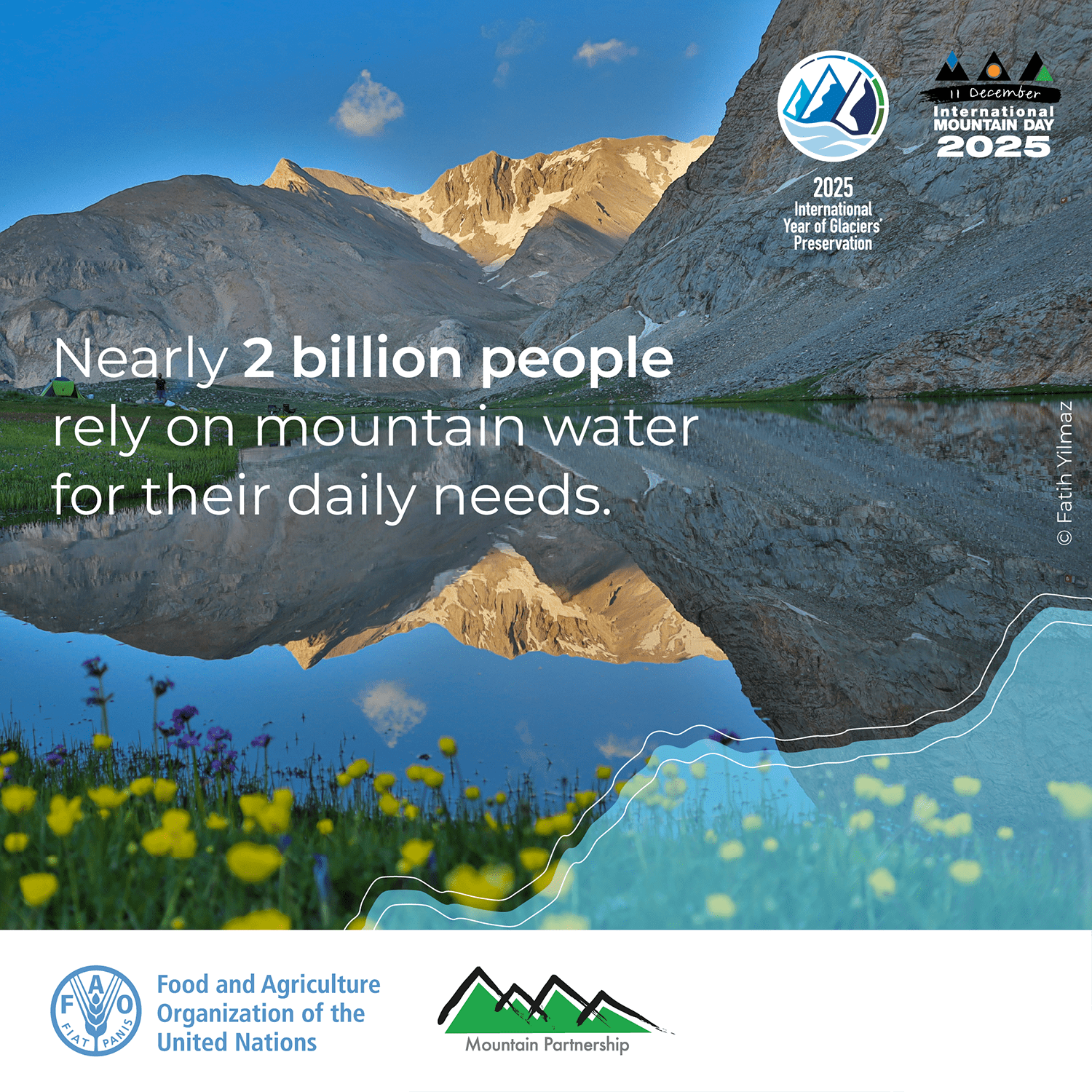
The IMD 2025 is a contribution to the International Year of Glaciers’ Preservation 2025, supporting efforts to underscore the critical role mountain regions play as a key source of global freshwater and ecosystem services. More than 2 billion people, including many Indigenous Peoples, rely on melt from glaciers and snow for their freshwater, including for their food security, livelihood, cultural and domestic needs. Immediate and collective action is needed to protect mountains and glaciers from the impacts of climate change. Reducing greenhouse gas emissions are critical for stabilizing the climate and preserving glaciers. Advancements in glacier data and monitoring can guide effective adaptation and mitigation strategies. Indigenous Peoples and youth can drive collective action and lead the way forward. National policies must Address glacier-related challenges, from integrated water management to the establishment of protected areas and alert systems for cryospheric risks. Global cooperation is essential to mobilize resources, share knowledge and ensure glaciers are safeguarded for future generations. As we dedicate IMD 2025 to glaciers, it is our shared responsibility to preserve these ancient ice formations, which are a crucial testimony of the Earth's history, the source of life for billions, and sacred places for many cultures. While “Glaciers matter for water, food and livelihoods in mountains and beyond” is the proposed theme, countries, communities and organizations can celebrate IMD 2025 in ways that resonate most with their challenges and priorities.
LIVESTREAM: The high-level event webcast is available in all 6 UN languages. Watch the Worldwide events to mark the IMD2025. on and around December 11th and the global event hosted by the FAO. Register to participate and Watch the webcast!
EXHIBITION: Exhibition and ice cream tasting, FAO Atrium.
11.35–15.00: From glaciers to cones - An opportunity to taste artisanal ice cream crafted with glacier and mountain water-fed ingredients by Slow Food producers in Italy, as well as high-value mountain products.
From 8-19 December 2025, an exhibit entitled "On the Trail of the Glaciers" exhibition will be held; This interactive exhibition will display a striking visual exploration of glacier retreat around the world through large-scale comparison photos.
FESTIVAL: Taking place every year in the run-up to or on International Mountain Day on December 11th, the Reading Mountains Festival 2025 will offer us an opportunity to showcase and celebrate the literary and cultural diversity of the Alps. This year, the Festival enters its eleventh edition, and if you have never been part of it, we warmly invite you to join in or attend an event! Learn more about the eleventh edition of the Reading Mountains Festival.
Mountain future Award: In celebration of International Mountain Day 2025, the Food and Agriculture Organization of the United Nations (FAO) is inviting institutions and individuals over 18 to submit proposals for transformative projects that contribute to a sustainable tomorrow for mountains, for a chance to win the 2025 Mountain Future Award. Project submissions should emphasize the following areas:
Innovation – Innovation should be a key aspect of the project proposal. This could encompass technological (including digital), social, policy, financial, and/or institutional innovations that address complex social, economic and environmental challenges in mountains.
Adaptation – Project proposals should promote climate adaptation. This could include adaptation strategies tailored to mountain ecosystems and communities, resilient agrifood systems, climate smart agriculture, ecosystem-based approaches to natural resource management, the integration of Indigenous knowledge systems or traditional techniques, and the promotion of circular economy.
Youth – The active, meaningful participation of youth in decision-making is essential for ensuring the long-term sustainability of mountain solutions. Project proposals should emphasize youth leadership, such as being youth-led and/or youth-focused, promoting universal and accessible training for young persons in mountains, and empowering young people to be agents of change through digital technology, research and entrepreneurship opportunities that contribute to the conservation and sustainable use of mountain resources. Along with international recognition, the three awardees will each receive seed funding of USD 5 000, generously provided by the following sponsors: the Arjun Gupta Family Foundation, Forte di Bard, and Polo Museale - Sapienza University of Rome. The winning proposals will also receive project incubation assistance from the FAO Mountain Partnership Secretariat.
The Global Mountain Explorer can help a variety of users – from hikers planning their next adventure, to scientists, resource managers and policy makers seeking information that is often sparse in these prominent yet often understudied landscapes. Mountains occupy anywhere from 12 to 31 percent of the land surface of the Earth, but despite their importance, surprisingly few attempts have been made to scientifically define and map these regions worldwide with detail. Visualizing Mountains!
WORLDWIDE CELEBRATIONS: Explore the 2025 International Mountain Day worldwide Workshops, seminars and side-events.
The ICIMOD is an intergovernmental institution working towards a greener, more inclusive, and climate resilient Hindu Kush Himalaya. Explore the ICIMOD Meetings, workshops, trainings and conferences and Get the list of IMD2024 upcoming events.
PUBLICATION: Glaciers and mountains: The food, water security and livelihoods nexus.Glaciers are more than frozen landscapes — they are lifelines. Mountain glaciers and other cryosphere components are crucial for agricultural production, livelihoods and water and food security with about 70 percent of the Earth’s freshwater existing as glaciers and ice caps. Climate change is a major driver of cryosphere change, including the melting of glaciers. Mountain water flows are therefore becoming more uncertain and variable, affecting the quantity, timing and quality of water for agriculture. When managed sustainably, mountain agriculture is not a driver of degradation but a solution, one that restores degraded ecosystems safeguards soil and water, enhances biodiversity and strengthens the resilience of mountain communities This brief, published by the Mountain Partnership on International Mountain Day, is a contribution to the International Year of Glaciers’ Preservation 2025 and it provides an opportunity to Raise awareness about the vital role of glaciers and other cryospherecomponents both within mountain settings anddownstream, and offers several considerations for policymakers and practitioners.
STATEMENTS: Read the statement of the United Nations Secretary-General on the International Mountain Day 2025 and the Statement of the Executive Secretary of the Convention on Biological Diversity International Mountain Day 2025; December 11th.

PODCASTS: The observance of the Day this year gives us a chance to increase awareness about the relevance of mountain ecosystems and call for nature-based solutions, best practices and investments that build resilience, reduce vulnerability and increase the ability of mountains to adapt to daily threats and extreme climatic events. Listen to the audio-podcasts!
CAMPAIGN MATERIALS: Communities and organizations are welcome to celebrate mountains by participating to the IMD2025 Photo contest. The photo contest aims to highlight the unique role mountains and glaciers play in the global water cycle, providing freshwater and essential ecosystem services. The posters, banners and other materials are available. Get the communication materials!
WHY WE CELEBRATE THE DAY?
HOW TO GET INVOLVED!
PARTNERSHIPS
The International Mountain Day has its roots in 1992, when the adoption of Chapter 13 of Agenda 21 “Managing Fragile Ecosystems: Sustainable Mountain Development” at the United Nations Conference on Environment and Development put a milestone in the history of mountain development. The increasing attention to the importance of mountains led the United Nations General Assembly to declare 2002 as International Year of Mountains. Since 2003, the International Mountain Day has been observed every year on December 11th to create awareness about the importance of mountains to life, to highlight the opportunities and constraints in mountain development and to build alliances that will bring positive change to mountain peoples and environments around the world. The United Nations General Assembly declared the year 2022 as International Year of Sustainable Mountain Development to place the sustainability and resilience of mountain ecosystems and communities at the heart of international processes, policies and investments within the framework of the 2030 Agenda for Sustainable Development. Whether you’re a business, NGO, journalist, government, city, civil society organization or individual, take advantage of this opportunity to call for action!
The International Mountain Day is hosted by the Food and Agriculture Organization of the United Nations (FAO), the Mountain Partnership, the World Meteorological Organization (WMO), the United Nations Environment Programme (UNEP), the International Centre for Integrated Mountain Development (ICIMOD). With the participation of the Association for Nature and Sustainable Development (ANDES), the Association for Nature Conservation Machaon International, the BioCarbon Registry, the Global International Terraced Landscapes Alliance (ITLA), the Global Mountain Action, the GRID-Arendal, the International Climbing and Mountaineering Federation (UIAA), the International Council for Game and Wildlife Conservation (CIC), the International Cryosphere Climate Initiative (ICCI), the International Institute for Environment and Development (IIED), the International Livestock Research Institute (ILRI), the International Potato Center (CIP), the International Scientific Committee on Research in the Alps (ISCAR), the Latin American Communications Network on Climate Change (LatinClima), the Millennium Institute, the Mountain Duck, the Mountain Research Initiative (MRI), the Mountain Sentinels Collaborative Network, the Sustainable Mountain Alliance, the International Institute for Sustainable Mountain Development, the The Living Chapel,the The Schneider Group; the Training for Health Equity Network (THEnet), the Women Organizing for Change in Agriculture and NRM (WOCAN), the World Economic Forum, the World Wildlife Fund International (WWF-International) and other major group organizations.
Help to celebrate the important role of women in mountains by entering our photo contest for International Mountain Day 2022 and you could win an action camera. All you need to do is take a photo celebrating the important role of women and girls in mountains. The winner of the photo contest will receive an action camera.
Plan an International Mountain Day event online or in person, or spread the word on your channels, and feature your event
improve livelihoods and boost local economies of mountain peoples.
Value the cultural diversity and traditional practices of mountain peoples.
Recognize unique and valuable local knowledge, traditions and cultural practices of the Indigenous and local populations in mountains
Contribute to effective land management strategies.
Help mountain peoples to obtain fair compensation for their specific quality products as well as provide added value to the customers.
Protect the natural and spiritual heritage of mountains.
Help limit threats to mountain ecosystems and their biodiversity.
,Build awareness of the impact of global warming on glaciers.
Provide early warning of mountain related risks and disasters;
Invest in adaptation.
Highlight the critical role of mountains in moving the world towards sustainable economic growth.