
PURPOSE: World Migratory Bird Day (WMBD) is an awareness-raising campaign highlighting the need for the conservation of migratory birds and their habitats. It aims to draw attention to the threats faced by migratory birds, their ecological importance, and the need for international cooperation to conserve them. The Day is celebrated bi-annually on the second Saturday in May and in October. a global campaign that aims to raise awareness of migratory birds and the need for international cooperation to conserve them. Activities to mark the day will be held globally on two peak days in both May and October.
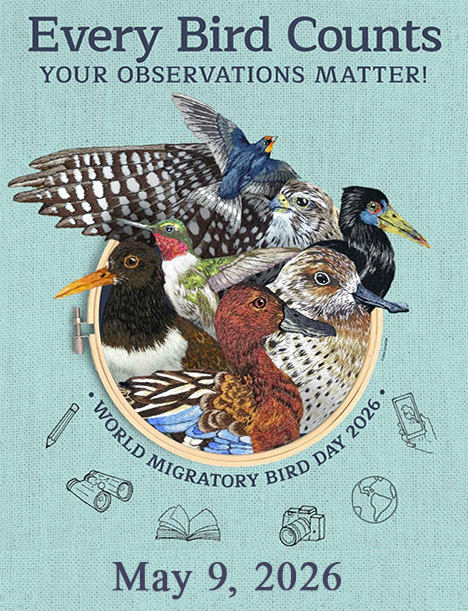
FORUM: “Every bird counts; Your observations matter!” World Migratory Bird Day 2026. The campaign emphasizes how public participation in tracking, monitoring, and collecting data helps conserve bird populations and habitats. The WMBD will focus on community science to aid conservation by encouraging action from all sectors, including national and local governments, businesses, community groups, and individuals worldwide. The theme will highlight the role of public participation in collecting data on migratory bird populations and their habitats and factors that impact their populations and contribute to our knowledge about how to protect them. Community science, ranging from backyard bird counts to large-scale coordinated surveys/schemes, provide information on species distribution, abundance trends, migration timing, and breeding success. This data is important to identify conservation priorities, and inform effective conservation action plans and strategies. By engaging individuals and communities in monitoring efforts, we not only gather scientific data but also build a deeper connection to nature, raise awareness about the challenges migratory birds face, and inspire direct conservation action. This theme will particularly resonate as it coincides with and will leverage promotional materials and visibility from a significant shorebird count happening in 2026, showcasing real-world application of monitoring efforts. It will also highlight other programs that involve the public and benefit bird conservation.
Key Messages - Community Science for Bird Conservation.
Community Science Makes Conservation Possible
Data Collection at Scale – Volunteers can gather information across vast areas and in places professionals can’t always reach. This large-scale participation is critical for understanding biodiversity and tracking environmental change.
Community Scientists Matter – Your observations matter. Whether you are recording information about the birds that are present where you live, the vegetation that they use, or other aspects of their life cycles, such as the quantity of plastics in the places where they are found.
Understanding and Addressing Threats
Spotting Vulnerable Populations – Community science can help to reveal when and where birds are most at risk from habitat loss, pollution, or building collisions.
Turning Data into Action – Your contributions inform conservation policies, guide habitat management, and help direct protection efforts where they’re most needed.
Accelerating Access to Science
Faster Discoveries – By sharing your data, you help researchers detect trends and respond more quickly to conservation challenges.
Science for Everyone – Community science welcomes people of all ages and backgrounds, making the scientific process accessible and empowering.
Collaboration Without Borders
Global Effort for Global Travelers – Migratory birds cross continents, so protecting them requires cooperation across countries and communities.
Local Action, Global Impact – Partner with neighbors, schools, and organizations to create bird-friendly spaces and address threats in your own community.
Tools That Make It Easy
Technology is at your finger tips – Apps like eBird, iNaturalist, Observation.org, Ornitho, BirdTrack, and BirdLasser make identification and data sharing simple.
Gateway to Nature – Using these tools not only aids research but reconnects people with the joy of birdwatching and nature.
The Power of Long-Term Data
Detecting Subtle Changes – Years of consistent observations reveal trends and shifts in populations that short-term studies miss.
Better Predictions, Better Protection – This long-term evidence strengthens conservation strategies for the future.
Ethics and Quality Matter
Be a Good Birder – Follow ethical birding practices to protect birds, minimize disturbance, and make sure your data remains reliable.
Quality Data for Policy – High-quality, verified data is essential for decisions at the local, national, and flyway scale.
Connection with Nature – Attention and participation in community science foster a deeper appreciation, and understanding of nature. Noticing the birds around you can inspire curiosity, joy, and a sense of connection to your local environment.
Calls to Action
Become a Community Scientist: Help protect the incredible journeys of migratory birds by observing, recording, joining an effort to gather information, and sharing what you see. Whether you’re 10 or 100, you can make a difference from your backyard, balcony, schoolyard, or local park.
Participate in Global, Regional, and Local Counts: Encourage participation in events like eBird, International Waterbird Census (IWC), Asian Waterbird Census (AWC), Global and European BirdWatch, the Great Backyard Bird Count, Christmas Bird Count, and local breeding bird surveys.
Contribute Observations to the Platforms that support Conservation Efforts: Promote regular submission of bird observations to global data collection platforms like International Waterbird Census (IWC), Asian Waterbird Census (AWC), Global and European BirdWatch, the Great Backyard Bird Count, Christmas Bird Count, and local breeding bird surveys.
Adopt a Monitoring Site: Encourage individuals or groups to regularly monitor a specific location for migratory birds whether in their local area or in other regions.
Join a Banding Station: Highlight opportunities to volunteer with bird banding operations. Even if you can’t handle birds directly, you can help with data entry, photography, or public outreach.
Report Sightings of Marked Birds: Educate the public on how to report color-banded or marked birds.
Advocate for Data-Driven Policy: Encourage communities to use monitoring data to support local and national conservation initiatives. Write to local leaders, share findings on social media, or attend public meetings. Encourage governments to actively support, encourage and use community science in their efforts to conserve birds and nature.
Support Community Science Programs: Encourage donations or volunteer time to organizations running bird monitoring projects. Donate to programs that train young birders, support monitoring projects, or manage bird data. Volunteer your time to help with education, outreach, or organizing local events like World Migratory Bird Day.
Learn About Nature: Build your knowledge by talking with other naturalists and helping others. Teach others what you know—especially kids and new birdwatchers. Learning together builds a community of informed, motivated community scientists.
Use Respectful Birding Practices: Help birds stay safe while you observe them: Don’t disturb nests, resting, or feeding birds. Avoid using playback sounds unless allowed. Respect habitats and leave no trace. Keep noise low and movement gentle.
Learn About Birds in your Area: Learn about the birds where you are at your school, your home, and throughout your community. Pay attention to which birds are present today and return over time to notice change. Create your own community science project to better understand birds in your area by observing, recording, and sharing what you see. Following the example of Joseph Grinnell and the Grinnell Survey, these local observations become lasting records that inform conservation decisions. Start where you are, keep watching, and help build the knowledge birds need for the future.
Join the conversations, please follow the hashtags: #WorldMigratoryBirdDay; #MigratoryBirds; #everybirdcounts; #Yourobservationsmatter;#WMBD2026 ; #9may.
EVENTS: In 2026, World Migratory Bird Day will be celebrated on two days, 9 May and 10 October, aligning with the cyclic nature of bird migration in different hemispheres. With bird-watching activities worldwide; The World Migratory Bird Day 2026 will be officially celebrated on the second Saturday of May in Canada and the US (May 09th in 2026), and the second Saturday of October in Mexico, Central and South America, and the Caribbean (October 10th in 2026). The partners behind World Migratory Bird Day are happy to announce that the theme for the 2026 campaign will be dedicated to creating bird-friendly cities and communities. The campaign will highlight the need for a healthy coexistence between humans and birds. It will focus on creating and adapting environments that support migratory bird populations across all communities, from bustling cities to smaller towns and communities. The campaign is a joint effort of the Convention on the Conservation of Migratory Species of Wild Animals (CMS), the African-Eurasian Migratory Waterbird Agreement (AEWA), Environment for the Americas and the EAAFP. The addition of the EAAFP to this Partnership will strengthen engagement and awareness for migratory birds in the East Asian-Australasian Flyway. Register to Participate; Watch the list of events related to birds and Explore some activities!
on Saturday May 9th, with guided bird walks, an introductory workshop on how to use the eBird app, and a Forestry for Maine Birds and Fish workshop with Maine Audubon’s Sarah Haggerty. You can hear more about other community science projects and how to participate through the Intro to iNaturalist webinar on May 12 andin-person follow-up session at Fields Pond on May 15 as well!. At the end of the day, it really does come back to the World Migratory Bird Day theme: every observation matters. Whether you’re spotting birds at your feeder, joining a walk, or helping track amphibians on a rainy night, you’re contributing to something bigger.
On Saturday, May 9th, 2026; From 8 am–2 pm, get involved in community science initiatives and explore the Schedule of events!
From 8 - 9:30 am: Bird Walk with Penobscot Valley Chapter members. Help us log as many species as possible at peak activity time!
From 10 am - 12:30 pm: Forestry for Maine Fish Workshop, for landowners or foresters curious about managing bird habitat
From 1 -2 pm: E-Bird Workshop with Nathaniel Austin. Learn how your observations can have an impact on bird conservation.
From 2 pm: Beginner Family Bird Walk.
On April 25, 2026; Muscatatuck's Annual Migratory Bird Day festival, Wings Over Muscatatuck, will be held by the Jackson County Visitor Center. This all day event celebrates the birds of Muscatatuck National Wildlife Refuge and the world! There will be birding stations, a program on cranes, a native plant sale, children's activities, live raptors, and much more!


PODCASTS: As migratory birds depend on a range of sites along their distribution area, the loss of wintering and stopover sites could have a dramatic impact on the birds’ chances of survival. Conversations about the history of bird migration and the Global Trends in Protection of Migratory Birds. Listen to the audio-podcasts!
Campaign materials: Join the Campaign“Every bird counts; Your observations matter!” in celebration of the World Migratory Bird Day 2026. We hope that the collective World Migratory Bird Day energy and commitment we witnessed in the past years will carry on this year and in the years to come. Explore the social media communication tool and Get the campaign materials!
WHY WE CELEBATE THE DAY?
The world Migratory Bird Day is celebrated to mitigate the threats faced by birds on their migratory routes. Flying long distances involves crossing many borders between countries with differing environmental politics, legislation and conservation measures. It is evident that international cooperation among governments, NGOs and other stakeholders is required along the entire flyway of a species in order to share knowledge and to coordinate conservation efforts. The legal framework and coordinating instruments necessary for such cooperation is provided by multilateral environmental agreements such as CMS and AEWA. The World Migratory Bird Day (WMBD) has a global outreach and is an effective tool to help raise global awareness of the threats faced by migratory birds, their ecological importance, and the need for international cooperation to conserve them. However, every day is Bird Day, and you can celebrate birds and host events any day of the year!
HOW TO GET INVOLVED?
Are you passionate about migratory birds? Would you like to help to raise awareness about them and to conserve them and their habitats? If so, please read the following list of ideas on how you can take action. Our goal is to help stimulate knowledge of, and international participation in WMBD.
,Reflect on the cyclical nature of bird migration with varying migration periods in the northern and southern hemispheres.
Let the world know why we celebrate migratory birds and how everyone can contribute to the conservation of them and their habitats
Provide water to birds.
Connect with the WMBD Social Media Community.
Be creative and produce a video about migratory birds, Translate parts of the WMBD materials into your own language.
Help us make WMBD a sustainable, thriving global initiative - take part in it!
PARTNERSHIPS
The World Migratory Bird Day is organized by The Convention on the Conservation of Migratory Species of Wild Animals; The Agreement on the Conservation of African-Eurasian Migratory Waterbirds; The Environment for the Americas with the support of Norwegian Environment Agency,Memorandum of Understanding on the Conservation of Migratory Birds of Prey in Africa and Eurasia, The Wetlands International, The International Council for Game and Wildlife Conservation (CIC); The International Union for Conservation of Nature (IUCN); The Birdlife International; The Ramsar Convention; The Convention on Biological Diversity (CBD); The UNEP; The BTO Tracking Studies; The Royal Society for the Protection of Birds (RSPB); The European Union of Bird Ringing (EURING); The African Bird Ringing Scheme (AFRING); The Russian Society for the Conservation and the study of Birds (BirdsRussia).