PURPOSE: 3 May acts as a reminder to governments of the need to respect the commitment made to press freedom and is also a day of reflection among media professionals about issues of press freedom and professional ethics. Just as importantly, World Press Freedom Day is a day of support for media workers which are targets for the restraint, or abolition, of press freedom. It is also a day of remembrance for those journalists who lost their lives in the pursuit of a story.
FORUM: “Shaping a Future at Peace” World Press Freedom Day 2026. By fostering access to reliable information, accountability, dialogue, and trust, press freedom and independent journalism are key to peace, economic recovery, sustainable development, and human rights. According to UNESCO’s World Trends Report 2022–2025, press freedom has experienced its steepest decline since 2012. This decline is comparable to that seen during the most unstable periods of the 20th century – the two world wars and the Cold War. Information manipulation, including the use of AI by malicious actors, is weakening trust and national security. At the same time, independent media face growing economic fragility. Self-censorship has grown by more than 60%, driven by fear of reprisals, online harassment, judicial intimidation, and economic pressure. The World Press Freedom Day (WPFD) 2026 offers a critical moment to reaffirm freedom of expression and to align journalism, technology (including AI), and human rights actors around practical ways to strengthen information ecosystems for the future. Hosted in Lusaka, Zambia, the WPFD 2026 brings together press freedom advocates and digital rights communities at a time when the boundaries between journalism, technology, civic space, and human rights are increasingly intertwined. Follow the conversation with the hashtags:#WPFD2025, #reportinginthebravenewworld, #ai, #WorldPressFreedomDay, #freedomofexpression, #PressFreedom, #journalism, #3may.
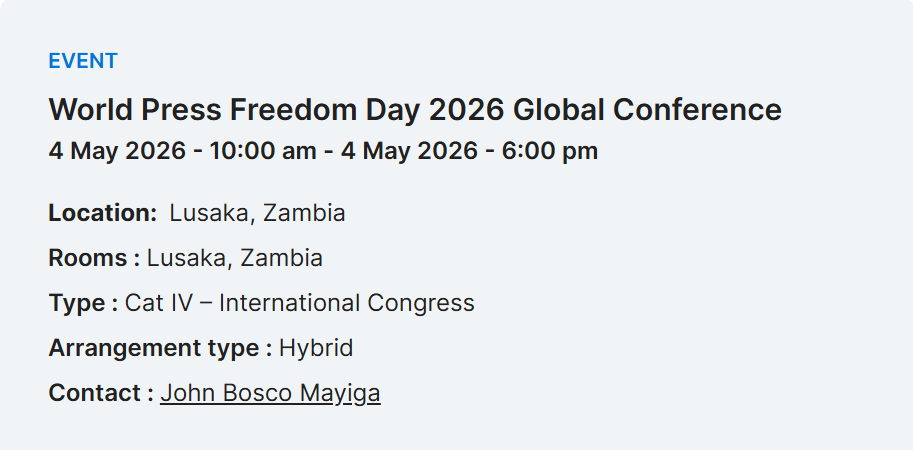
EVENTS: On 4-5 May in Lusaka, Zambia. The World Press Freedom Day 2026 conference “Shaping a Future at Peace” will be held. The conference will offer a critical moment to reaffirm freedom of expression both as a normative and empirical lever for shaping the future of information societies. On May 5, several side events will take place, including the African Media Convention (organized by TAEF) and the Academic Conference (University of Zambia). For more information contact wpfd@unesco.org, Register to participate!
AGENDA PROGRAMME
May 4th, 2026 "Shaping a Future at Peace, Promoting Press Freedom for Human Rights, Development, and Security" - DAY I - Mulungushi Building - Mulungushi International Conference Centre.
7:30 - 9:15 - Badge pick-up Mulungushi Building Main Auditorium
9:15 - 9:25 - Artistic performanceAfrica Dance Factory
9:25 - 9:30 - Opening Masters of Ceremony: Ms. Jacqueline Chishimba
Mr. Franklyn Tembo Jr.
9:30 - 9:45 - Set the scene Ms. Mwiza Zulu, Artist, Activist and Content Creator
09:45 - 10:00 - Testimonial Mr. Mohamed Zakaria photojournalist and filmmaker known for courageous documentation of the humanitarian crisis in Sudan’s ongoing civil war
10:00 - 10:30 - Opening addressesMs Mariya Gabriel, Assistant Director-General Communication and Information, UNESCO
H.E. Mr Takehiro Kano, Ambassador, Permanent Delegate of Japan to UNESCO and Chair of the International Programme for the Development of Communication (IPDC)
Hon. Mr Cornelius Mweetwa, MP, Minister of Information and Media, Republic of Zambia.
10:30- 10:40 - Lightning Talk Prof Chaloka Beyani, UN Under-Secretary General and Special Advisor to the Secretary -General on the Prevention of Genocide
10:40 - 10:05 - Coffee Break
11:05- 11:35 - Launch of the Southern Africa Press Freedom Report.
Report launch and discussion: Mr Tabani Moyo, Executive Director. Media Institute of Southern Africa (MISA).
Discussion of the Report:
Mr Morden Mayembe Director for Press and Media Development in the Zambia Ministry of Information and Media,
Mr Bongani Mkhaliphi, Government of Eswatini,
Mr Cosmas Chitauro – Government of Zimbabwe
Ms Susan Makore, Managing Director of the Global Women in News Team, World Association of News Publishers (WAN-IFRA)
MODERATOR : Mr Al Amin Yussuf, CI Regional adviser for Southern Africa, UNESCO
11:50 - 12:35 - PLENARY I - Press Freedom, Peace, Security and Economic Development
This panel examines the importance of journalism in conflict, crisis, recovery, and peacebuilding contexts, including “zones of silence,” journalist safety, and the fight against impunity, recognizing that protecting journalists is inseparable from protecting societies’ right to information.H.E. Mr Churchill Ewumbue-Monono, Ambassador of Cameroon to Ethiopia and Djibouti, Permanent Representative to the African Union and the United Nations Economic Commission for Africa
Mr Gilbert Sendugwa, Executive Director, Africa Freedom of Information
Dr Phathiswa Magopeni Tshangana, Executive Director, Press Council of South Africa & Chairperson of NIMCA
Dr Vera Slavtcheva-Petkova, Reader in Global Journalism and Media, University of Liverpool
Mr Andrew Dabalen, Chief Economist for Africa, World Bank video
Moderator: Ms. Misako Ito, Regional Adviser for Communication and Information in Africa, UNESCO
Q&A
12:35 - 14:00 - Lunch Break
14:00 - 14:40 - PLENARY II - Digital Transformation, Artificial Intelligence, and Information Integrity
This panel analyzes how digital platforms, algorithms, artificial intelligence, and new information actors reshape freedom of expression, media independence, and public trust and how governance frameworks grounded in human rights can respond to these transformations.
Dr Tabani Moyo, Regional Director of the Media Institute of Southern Africa (MISA), member of the African Union’s Working Group on Artificial Intelligence
Ms Tracy Manners, Deputy Vice President, Director of Global Affairs, Meta Oversight Board
Ms Juliet Nanfuka, Researcher, Technology, Society & Power CIPESA
Moderator: Ms. Teldah Mawarire, Media & digital expert
Q&A
14:40 - 15:30 - PLENARY III - Media Viability, Pluralism and Inclusion
This panel explores pathways to viable, independent, and diverse media ecosystems, including support to local and community media, gender equality, inclusion of marginalized voices, and policies that strengthen long-term resilience.
Dr Joe Ageyo, Editor in Chief, Nation Media Group
Ms Susan Makore, Managing Director of the Global Women in News Team, World Association of News Publishers (WAN-IFRA)
H.E. Ms Karolina Stasiak, Ambassador of the European Union to Zambia and COMESA
H.E. Mr Takehiro Kano, Ambassador, Permanent Delegate of Japan to UNESCO and Chair of the International Programme for the Development of Communication (IPDC)
Moderator: Mr. Carlos Van Meek, Deputy Executive Director of Editorial, Digital Division, Al Jazeera
Q&A
15:30 - 15:45 - Coffee Break
17:45 - 18:00 - Closing Ceremony
This segment provides an opportunity to reflect on the key outcomes and messages from the conference. It will highlight the main takeaways and reinforce commitments to advancing press freedom. The session is also designed to set the stage for continued action beyond the event.Hon. Cornelius Mweetwa, MP, Minister of Information and Media, Government of Zambia
Ms. Mariya Gabriel, Assistant Director-General Communication and Information, UNESCO
May 5th, 2026 - The Side events organized by World Press Freedom Day partners will take place in the Mulungushi Wing within the Mulungushi International Conference Centre. Registration for the World Press Freedom Day conference on 4 May grants you access to side events on May 5. However, please note that you will need to pick up your badge on May 4 from 07:00-09:15.
9:00 - 16:00 - African Media Convention TAEF will take place int the main auditorium.
Hosted by the AMC Steering Committee, chaired by Mr. Churchill Otieno, President of The African Editors’ Forum (TAEF), in collaboration with UNESCO, the African Union Commission (AUC), the Network of Independent Media Councils in Africa (NIMCA), the M20 and other partners. Contact: izak.minnaar@gmail.com
9:00 - 16:00 - Academic Conference of the University of Zambia will take place in Room 3.
The Academic Conference on the Safety of Journalists brings together scholars, policymakers, journalists, and civil society actors to examine current challenges and emerging research related to journalist safety worldwide. The conference provides a platform to share academic insights, policy perspectives, and practical approaches to strengthening protection mechanisms, combating impunity, and advancing media freedom. Contact: Vera.Slavtcheva-Petkova@liverpool.ac.uk or brenda.bukowa@unza.ac.zm
9:00 - 11:00 - Supporting Economic Journalism: Understanding the IMF and Its Resources for Journalists IMF will take place in Room 1.
This is a closed‑door side event that will offer a practical opportunity to engage directly with locally based and international journalists and media practitioners. Through a presentation by the IMF Resident Representative in Zambia, complemented by a session from an IMF communications focal point on the organization's communications tools and key data access points, the event would help journalists better understand and use IMF analysis, data, and policy messaging in their reporting. By demystifying IMF tools and strengthening journalists’ access to reliable economic information, the Fund would support informed public debate and higher‑quality economic reporting, in line with its mandate and the objectives of World Press Freedom Day. Please RSVP for this closed-door side event here: Fill out form or Contact: Rabner@imf.org; akanyegirire@imf.org
11:30 - 13:00 - Gender, Safety and Press Freedom: What’s at StakeWAN-IFRA Women in News, UNESCO
This panel will examine gender equality as a core press freedom and safety issue, bringing together perspectives from research, funding, lived experience, and policy. It comes at a critical moment, as media organisations worldwide continue to confront persistent challenges around harassment, safety, and equal participation in the newsroom. The discussion also reflects upcoming research by WAN-IFRA Women in News (WIN) in partnership with BBC Media Action, and City St George's, University of London, which explores prevalence, reporting mechanisms, and actions taken following reporting. It also aligns with UNESCO’s World Trends Report and its ongoing work on online harassment. Contact: farah.wael@womeninnews.org
14:00 - 16:00 - Stakeholder Validation Workshop of the Africa Media and Information Literacy Framework. UNESCO and the African Union
Following recommendations from the 3rd Africa Media Convention and the Africa AI Strategy, the African Union Commission commissioned the development of the Africa Media and Information Literacy Framework with UNESCO’s support. Led by MIL expert Wallace Gichunge, the draft Framework was developed throughout 2025 and is now under review by UNESCO and the AU, ahead of ministerial consideration in 2026. The session will focus on validation, collaboration, action planning and raising awareness of the importance of MIL across the continent. Contact: wgichunge@gmail.com
WEBINAR: Watch the Launch of the new report Freedom in the World 2026 entitled ‘‘The growing shadow of autocracy’’.
Celebrations around the World: These events are independently organized and the content of these is the responsibility of the organizer. The views and opinions expressed in the events are those of the speakers and do not necessarily reflect the official policy or position of UNESCO. Explore the World Press Freedom Day 2026 commemorations all around the world.
PRIZES: The observance will be also the occasion to award the UNESCO/Guillermo Cano World Press Freedom Prize, which recognizes and honors the contributions of journalists, particularly those who risk their lives to provide essential information to the public. You can Watch in live the award ceremony!
STATEMENTS: Read the statement of The United Nations Secretary-General on World Press Freedom Day 2026 and statement of the Director-General of UNESCO, on the occasion of World Press Freedom Day 2026.
PUBLICATION: The Freedom in the World report 2026 entitled ‘‘The growing shadow of autocracy’’ warns of escalating attacks on journalists worldwide — killings, arbitrary detention, surveillance, and mounting economic pressure. An urgent call to States, tech companies, and society to protect those who speak truth to power. Read the full pubication!
RSF World Press Freedom Index 2025: economic fragility a leading threat to press freedom. Although physical attacks against journalists are the most visible violations of press freedom, economic pressure is also a major, more insidious problem. The economic indicator on the RSF World Press Freedom Index now stands at an unprecedented, critical low as its decline continued in 2025. As a result, the global state of press freedom is now classified as a “difficult situation” for the first time in the history of the Index.

PODCASTS: In 2024, 82 journalists lost their lives, just for doing their job. To mark World Press Freedom Day on May 3rd, we honor all those who risk their safety to defend the public’s right to know – including the Nicaraguan newspaper La Prensa, winner of this year’s UNESCO/Guillermo Cano World Press Freedom Prize. Let us engage together to protect press freedom, reaffirm the vital importance of freedom of expression, and shape a future where human rights are at the centre of decision making at the global, regional and national level. Listen to the audio-podcasts!
CAMPAIGN MATERIALS: “Shaping a Future at Peace” World Press Freedom Day 2026. On #WorldPressFreedomDay, we celebrate and support journalists and media outlets who are targeted for the restraint, or abolition, of press freedom. Download the visual identity in 6 UN languages and Disseminate the campaign across different media and social media outlets. Get the campaign materials!
WHY WE CELEBRATE THE DAY?
The World Press Freedom Day invites us to celebrate the fundamental principles of press freedom, to evaluate press freedom around the world, to defend the media from attacks on their independence and to pay tribute to journalists who have lost their lives in the exercise of their profession.
In the 78 years since the adoption of the Universal Declaration, the right to freedom of expression has been further affirmed and enshrined in numerous international instruments; the 1966 International Covenant on Civil and Political Rights, the 1989 Convention on the Rights of the Child, and the 2006 Convention on the Rights of Persons with Disabilities, among many other global and regional standards. While all human rights are universal, interdependent, indivisible and interrelated; freedom of expression’s function as an enabler for other human rights has been further explored by relevant United Nations treaty bodies and committees in charge of international instruments, who published their interpretation of provisions in the form of general comments or recommendations. On this occasion, the global community will debate and set the agenda for both the development of human rights and how to protect them in an everchanging world, and World Press Freedom Day will serve as an opportunity to put a strong focus on freedom of expression within the overall human rights agenda.
ACTIONS
Raise awareness about the issues of the Day’s theme.
Underline the importance of information within our online media environment.
Celebrate the day for instance by teaming up with organizations promoting environmental causes, women’s rights, children'srights, indigenous rights, digital rights, the fight against corruption and others.
Mobilize top newspapers and media organizations and leading journalists, experts, influencers, and activists around the world.
Support independent journalism.
Ensure greater transparency of online platforms.
Develop media and information literacy.
Engage top media newspapers, outlets and broadcasters (TV and radio) from around the world to disseminate the campaign materials.
Organize events that spotlight thelink between press freedom, freedom of expression and other rights.
PARTNERSHIPS
The events are organized by the World Press Freedom's community including civil society organizations, universities, media freedom networks and other New York-based and international organizations. This year’s Special 33rd anniversary celebration of World Press Freedom Day is therefore a call to recentre press freedom, as well as independent, pluralistic and diverse media, as necessary key to the enjoyment of all other human rights. This anniversary coincides with the 33rd anniversary of the Vienna Conference and its Declaration and Programme of Action on Human Rights, which established important institutions safeguarding human rights, and with the 78th anniversary of the adoption of the Universal Declaration of Human Rights.
UNESCO coordinates the Day, which involve around 100 celebrations in countries around the globe and leads the main celebration by organizing a global conference together with the host government and various partners working in the field of freedom of expression. For more information Contact wpfd@unesco.org