PURPOSE: The United Nations General Assembly established 24 April as International Day for Multilateralism and Diplomacy for Peace to Preserve the values of multilateralism and international cooperation, which underpin the UN Charter and the 2030 Agenda for Sustainable Development, is fundamental to promote and support the three pillars of the UN - peace and security, development and human rights.
FORUM: "Multilateralism is part of the United Nations' DNA" International Day of Multilateralism and Diplomacy for Peace 2026. As the world gathers to celebrate the achievements of multilateralism and diplomacy, which has its best representation in the United Nations, humanity, and particularly the peoples of the Global South, suffers from the consequences of a global crisis with multiple dimensions, including, among others, in the climate, food, energy and finance fields, which, coupled with the negative impacts of ongoing wars and protracted conflicts, such as the one in the Gaza Strip, is only keeping us off track from honoring our pledge of leaving no one behind and ensuring the attainment, by 2030, of the Sustainable Development Goals (SDGs). In many cases, the lack of progress in effectively and comprehensively redressing such challenges and threats, despite being common, although with different levels of intensity, is derived from either of the following ones, which, at its very core, has differing understanding of core values, such as international cooperation and solidarity:
Lack of willingness to engage, compromise and/or accommodate divergent views, positions and priorities;
Assumption of a zero-sum mentalities and departure from consensus-building approaches;
Resort to supremacist, punitive, divisive or confrontational approaches
and/or measures;
Non-fulfillment of international obligations and commitments, coupled with selective approaches and/or accommodative interpretations of the provisions of the UN Charter, as part of efforts to impose a so-called “rules-based order” that, insofar as unknown and vague, may only serve agendas of a dubious nature; or
Resort to group unilateralism, when real and genuine multilateralism – inclusive and consultative – is perceived as not necessarily serving the purpose and/or interests of certain States.
Against this backdrop, and taking into account the persistent polarization and continued geopolitical tensions in international relations, a transformation of current diplomacy seems increasingly imminent. But not just any transformation. The diplomacy of the future – which shall necessarily still be rooted in the UN Charter and the norms of international law collectively developed over the past 79 years – must also be able to support global efforts for overcoming both growing and common challenges and threats that humanity is currently facing in multiple areas, and in which the central role of States is critical.
The United Nations, an intergovernmental Organization established in 1945 from the shatters of World War II, is at the service of its Member States for reaching agreements and taking collective decisions. Its founding Charter clearly establishes that the United Nations is a “centre for harmonizing the actions of nations in the attainment of these common ends”, in order to “take effective collective measures for the prevention and removal of threats to the peace”, to “develop friendly relations among nations based on respect for the principle of equal rights and self-determination of peoples”, and to “achieve international cooperation”. To this end, the United Nations must, in particular, work to solve “international problems of an economic, social, cultural, or humanitarian character” and develop “respect for human rights and for fundamental freedoms for all”.Nevertheless, there is a growing tendency to resort to policies and methods that seek to suppress developing States and their needs. For instance, there is an increasing recourse to unilateralism, whether in the form of group unilateralism or unilateral, protectionist and/or isolationist measures; to attempts aimed at imposing a so-called “rules-based order” that not only remains vague, but which has never been agreed upon and has the potential to undermine both the rule of law at the international level and the very tenets of the UN Charter; and to efforts aimed at replacing, minimizing or equating the central and leading role of States, in the context of intergovernmental processes and debates, particularly at the United Nations, with that of non-State actors, especially nongovernmental organizations (NGOs), which are largely based in and financed by the developed world. With respect to the latter phenomenon, while acknowledging the contribution that relevant stake-holders may indeed have to specific processes and conversations at the United Nations, we ought to note how striking it is to see that multilateralism is being slowly – yet effectively – replaced by multi-stakeholderism; an approach that ultimately dilutes the role of States, especially those in the Global South, diminishing their voice and their chances of really making meaningful contributions and ultimately having a significant impact on critical debates and decision-making processes on issues that, no doubt, will have an incidence on the lives of their peoples and the future of their nations. Hence, as things stand, multilateralism, far from being revitalized, strengthened or reinvigorated to better respond to the challenges of the 21st century, it is being threatened by growing trends and challenges that detract from the participation of developing States and make it nearly impossible to achieve the goals we have set ourselves, particularly the realization of that other possible world of peace and prosperity a reality for all. With world leaders set to convene at the UN Summit of the Future this September to reaffirm their dedication to peace, sustainable development, and protection of human rights, the importance of multilateralism and diplomacy is more paramount than ever. Follow the conversation with the hashtags: #InternationalDayforMultilateralismandDiplomacyforPeace; #24April; #MultilateralismDay; #DiplomacyDay.
EVENTS: On April 24th, to mark the International Day of Multilateralism and Diplomacy for Peace 2026, a high-level panel discussion will be held address global challenges, to showcase the advantages of multilateralism and diplomacy for peace and to reflect on the values of multilateralism and diplomacy in today’s interconnected world. In the last 80 years, global cooperation in the United Nations framework has been through ups and downs, being constantly influenced by various global challenges. The United Nations is a reflection of its Member States and is as efficient, or ineffective, as its Member States make it. The world has become progressively more politically fragmented and at the same time interconnected. The process of globalization – in particular the technological advances in communication and transport – shrank the world. It created new opportunities, but also increased inequalities between developed and developing countries as well as within countries. Multilateral cooperation has had to evolve over the years with changing circumstances, but its significance in addressing global challenges has only increased dramatically with the passage of time. Register to participate!
On Friday, April 24th, 2026 at UNHQ starting at 16:00 pm EST. An interactive dialogue entitled ’’The Pact for the Future and the UN80 Initiative: From Commitments to Delivery‘‘will be held by the United Nations General Assembly to provide a platform for Member States to reflect on how the commitments of the Pact for the Future can be operationalized and supported through the UN80 Initiative. The meeting will seek views on how political commitments under the Pact for the Future can inform institutional reform efforts, and how UN80 Initiative-related processes can support effective implementation and accountability. The Guiding questions:
1. How can the Pact for the Future provide strategic guidance for UN80 Initiative-related reform efforts, ensuring that institutional change supports agreed-upon political priorities?
2. In what ways can the UN80 Initiative contribute to more effective implementation of the Pact for the Future, including through improved coherence, coordination, and accountability across the UN system?
The Pact for the Future remains the most comprehensive and recently agreed universal political framework adopted by Member States in recent times and represents a strong collective commitment to strengthening multilateral cooperation and addressing the complex and interconnected challenges facing the international community. Its implementation, which lies largely in the hands of Member States, will require sustained political will, strengthened cooperation and continued engagement to translate its commitments into tangible results. Read the concept note and Watch the livestream!
PUBLICATIONS: The GLOBAL TRENDS: Prospects for Development and Peace - Multilateral Cooperation for People and Planet from the Institute for Development and Peace (INEF) at the University of Duisburg-Essen and the Development and Peace Foundation in Bonn. Read the full publication!
The United Nations have launched a report entitled “Effective Multilateralism.” that outlines an ambitious plan to strengthen the multilateral system, ensuring it is better positioned to address current and future challenges – from the climate crisis to rising inequality, lack of finance for sustainable development, and increasing threats to democracy and stability.

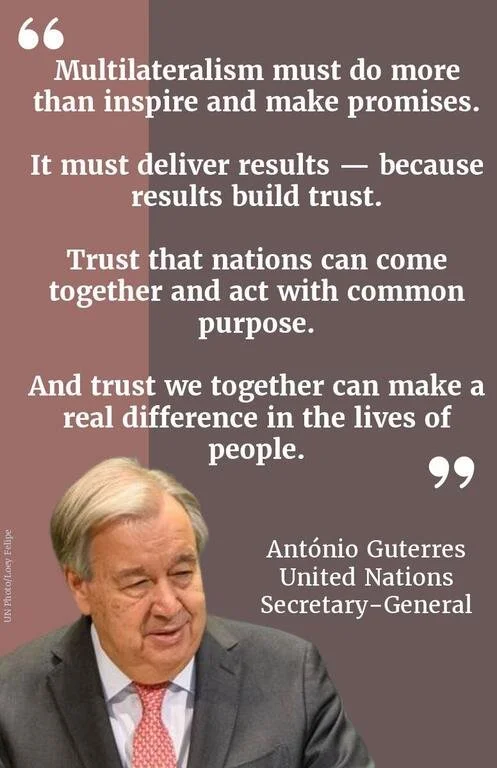

Under the agenda: "Maintenance of international peace and security”.
With United Nations Secretary-General, António Guterres.
Sergey Lavrov, the Minister for Foreign Affairs of the Russian Federation, is expected to chair the debate.
RECOMMENDATIONS
Community engagement is at the heart of successful peacebuilding and sustaining peace efforts.
1. DEEPER UNDERSTANDING OF LOCAL CONTEXT THROUGH RESPECTFUL, COHERENT AND FLEXIBLE ENGAGEMENT
2.OPERATIONAL AND STRATEGIC COHERENCE AND EFFECTIVE COORDINATION IN COMMUNITY ENGAGEMENT ACROSS THE UN IN THE FIELD
3. SAFETY AND PROTECTION IN RESTRICTED ENVIRONMENTS THROUGH CONFLICT-SENSITIVE AND RISK-INFORMED APPROACHES
3. SAFETY AND PROTECTION IN RESTRICTED ENVIRONMENTS THROUGH CONFLICT-SENSITIVE AND RISK-INFORMED APPROACHES
4. INCLUSIVE AND MEANINGFUL PARTICIPATION OF LOCAL CIVIL SOCIETY ACTORS
5. COMMUNITY-BASED CAPACITY-BUILDING, INCLUDING FINANCING FOR PEACEBUILDING
6. MEANINGFUL PARTICIPATION OF LOCAL WOMEN AND WOMEN CIVIL SOCIETY ACTORS IN PEACEBUILDING AND SUSTAINING PEACE
7. MEANINGFUL YOUTH ENGAGEMENT IN PEACEBUILDING AND SUSTAINING PEACE AT THE LOCAL LEVEL
PODCASTS: Conflict prevention remains, however, a relatively under-publicized aspect of the UN's work. Meanwhile, the most efficient and desirable employment of diplomacy is to ease tensions before they result in conflict, or, if conflict breaks out, to act swiftly to contain it and resolve its underlying causes. Preventive diplomacy is very important in support ing United Nations efforts to assist in the peaceful settlement of disputes. Listen to the audio-podcasts!
CAMPAIGN MATERIALS: on April 24th, Make a commitment and Join the campaign to demand trusted and effective multilateral cooperation. The Commitment to multilateralism and Engagement in international peace and security during the day will be reaffirmed by most world leaders. Get the campaign materials!
Local civil society actors, including women and youth, are often primary agents of peacebuilding, playing key roles in conflict-affected societies and in situations of extreme fragility or transition. They are critical in promoting confidence and trust, encouraging cooperation, creating incentives for collective action and ensuring that efforts are adapted to local and national contexts. Their contributions range from providing basic services to enhancing cohesion and stability; from enabling communities to influence social norms to mediating relationships between the government and people through dialogue or mechanisms for state accountability. As such, community engagement with local civil society actors is a central component of peacebuilding and sustaining peace.
Why We celebrate the Day?
We observe the International Day of Multilateralism and Diplomacy for Peace to Preserve the values of multilateralism and international cooperation, to renew our commitment to global multilateral solutions that deliver for people and planet.
ACTIONS
Establish a more networked multilateralism, with stronger coordination between regional and international organizations, international financial institutions and public/private alliances.
Build an inclusive multilateralism, that draws on civil society, business, local and regional authorities and others, and shares power more broadly and fairly.
Developing multilateral action to address the climate crisis, and to build stronger, safer communities and societies.
ORGANIZERS
The International Day of Multilateralism and Diplomacy for Peace is host by the United Nations General Assembly; The U.N. Security Council; The U.N. Department of Political and Peacebuilding Affairs; The U.N. Peacekeeping Operations; The UNESCO and the Special and Personal Representatives, Envoys and Advisers of the Secretary-General in the field.