PURPOSE: In order to achieve full and equal access to and participation in science for women and girls, the empowerment of women and girls, the United Nations General Assembly declaring 11 February as the International Day of Women and Girls in Science. On 20 December 2013, the General Assembly adopted a resolution on science, technology and innovation for development, in which it recognized that full and equal access to and participation in science, technology and innovation for women and girls of all ages is imperative for achieving gender equality and the empowerment of women and girls.
FORUM: “From vision to impact: Redefining STEM by closing the gender gap.“ International Day of Women and Girls in Science 2026. Today, women continue to represent less than one third of the world's researchers. Closing the gender gap matters not only for fairness, but also for the quality, relevance and impact of science, technology and innovation. Science in the 21st century is dynamic, collaborative and diverse, serving as a powerful tool for engaging with the world and tackling global challenges. Today, a background in science opens doors to a wide range of career opportunities that extend well beyond traditional laboratory professions. Moreover, the profiles of scientists are far more varied than the conventional stereotypes suggest. From a gender perspective, pioneers like Marie Curie have demonstrated that women can shape and lead scientific disciplines, but her legacy as one of the few widely recognized female figures in science highlights the urgent need for greater progress. This edition will highlight the positive impact of inclusivity through personal testimonies and evidence-based discussions. Panelists from diverse regions and professional backgrounds will share concrete measures that have proven effective in reducing the gender gap in four key areas: (1) Health research; (2) Cybersecurity (3) Artificial intelligence (4) Scientific entrepreneurship. They will also reflect on the conditions that enabled these successes and how such practices can be adapted or scaled in other contexts.Therefore, this important anniversary for the IDWGS aims to reflect the expansive reach of science and celebrate the contributions of women in science worldwide. Follow the conversations with the hashtags: #11February, #WomeninScience, #GirlsinScience, #GirlsInSTEM, #STEMEquality, #WomenInTech.
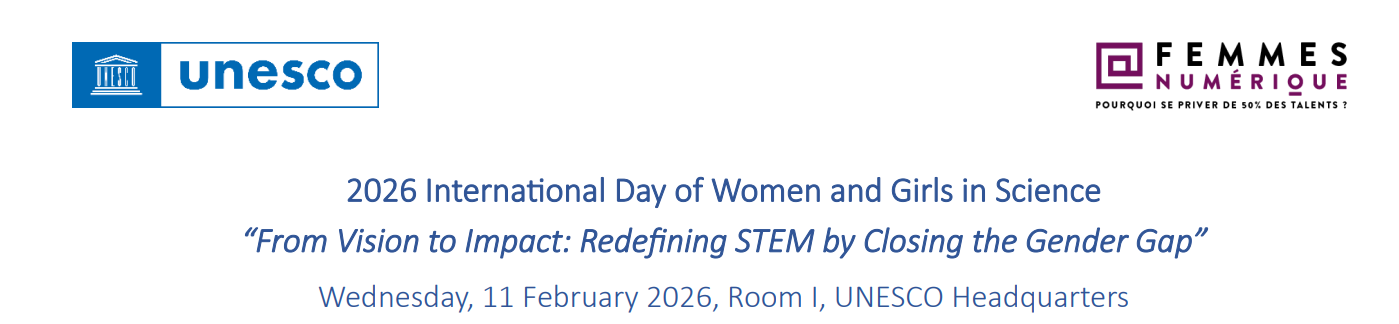
EVENTS: At UNESCO Headquarters (Room I), on wednesday, February 11Th, from 9:30 a.m. to 12:30 p.m. | 2:00 p.m. to 5:00 p.m. to mark the 2026 IDWGS celebration, the special hybrid event will take place under the theme: "From vision to impact: Redefining STEM by closing the gender gap". The 11th anniversary of the International Day of Women and Girls in Science will bring together Member States, early-career and accomplished scientists, stakeholders from the public and private sectors, UNESCO scientific networks and Chairs, journalists, as well as students. Building on the 2024 UNESCO Call to Action “Closing the Gender Gap in Science” and the 2025 “Imagine a world with more women in science #EveryVoiceInScience” campaign, the 2026 celebration shifts the focus from recommendations and reflection to showcasing existing good practices and solutions for building more inclusive Science, Technology, Engineering and Mathematics (STEM) ecosystems., the event will highlight concrete actions and good practices that are driving more inclusive STEM ecosystems worldwide..+ It will bring together rising and renowned scientists (including from the L’Oréal-UNESCO For Women in Science Programme and OWSD Chapters). Organized in collaboration with Femmes@Numérique, discussions will place a particular emphasis on new and emerging technologies and their role in closing the gender gap in STEM. This edition’s roundtables will highlight the positive impact of inclusivity through personal testimonies and evidence-based discussions. Panelists from diverse regions and professional backgrounds will share concrete measures that have proven effective in reducing the gender gap in their respective fields – health research, cybersecurity, artificial intelligence, and scientific entrepreneurship - and will explain the conditions that enabled their success. The event will place a particular emphasis on the use of new and emerging technologies in STEM fields and their impact on the gender gap. By bringing together expertise from across UNESCO’s sectors, the discussions will explore the growing influence of digital transformation on scientific research and innovation, from education to employment, and the need for gender-transformative approaches to ensure that technological progress benefits everyone.
Expected outcomes Through insights shared by panelists and interactive exchanges with the audience, the event aims: • to raise awareness of the essential contributions of women to scientific and technological innovation; • to provide participants with a clearer understanding of practical measures that have proven effective in reducing gender inequalities across different STEM sectors, and how these approaches can be adapted, scaled, or replicated in their own institutions and context; and • to invite stakeholders to consider how solutions must evolve in an era where new and emerging technologies increasingly shape scientific research, and how gender-responsive approaches can ensure these technologies are developed and used ethically and inclusively.
By fostering dialogue across sectors, from governments and private industry to academia and civil society, the 2026 IDWGS celebration seeks to strengthen collective commitment, encourage new partnerships, and generate follow-up actions that contribute to advancing gender equality in science. The discussions and outcomes will also feed into UNESCO’s ongoing work in this field and the implementation of the UNESCO Call to Action. Explore the sessions and register to participate to this hybrid event Online via (Zoom) or here for an in person participation. For further information please contact us at fwis@unesco.org.
AT UNHQ - On February 11th 2026, from 10:00 to 18:00, in the Conference Room 1 (CR-1) at the UN Headquarters will be held an High-level event to celebrate the 11th International Day of Women and Girls in Science Assembly entitled "IDEAS: Bringing Everyone Forward for Sustainable and Equitable Development" organized by the Royal Academy of Science International Trust (RASIT), the Permanent Mission of Malta and Co-organized by Permanent Missions of Antigua And Barbuda, Azerbaijan, Colombia, Croatia, Cyprus, Denmark, Greece, Ireland, Kazakhstan, Latvia, Peru, Philippines, Qatar, Republic of Korea, Romania, San Marino, Slovenia, as well as the African Union, the League of Arab States, International Telecommunication Union (ITU), World Intellectual Pproperty Organization (WIPO), and United Nations Industrial Development Organization (UNIDO). The 11th International Day of Women and Girls in Science (IDWGIS) Assembly focuses on bridging the gender gap in STEM, promoting sustainable development (SDGs), and features the first assembly moderated by Girls in Science. Get the concept note and watch the livestream (Part I) and the livestream (Part II).
INITIATIVES: In 2026, initiatives for women in science focus on building inclusive STEM ecosystems, showcasing solutions, and leveraging emerging tech like AI, highlighted by the UNESCO International Day of Women and Girls in Science on Feb 11, themed "From Vision to Impact," emphasizing real-world solutions. Key activities include global events, national programs like the L'Oréal-UNESCO For Women in Science Awards in various countries (Switzerland, Italy, Germany), and local seminars, all aiming to empower women, close gender gaps, and inspire future generations in science. Learn more about the current edition of the German National Program 2026 which promotes female early-career scientists. Call for application.
STATEMENTS: Read the statement of the United Nations Secretary-General on the International Day of Women and Girls in Science 2026: February 11th and the statement from the Director-General of UNESCO on the occasion of the International Day of Women and Girls in Science 2026, February 11th.







PODCASTS: Tackling some of the greatest challenges of the Agenda for Sustainable Development -- from improving health to combating climate change -- will rely on harnessing all talent. That means getting more women working in these fields. Diversity in research expands the pool of talented researchers, bringing in fresh perspectives, talent and creativity. Listen to the audio-podcasts!
CAMPAIGN MATERIALS: This Day is a reminder that women and girls play a critical role in science and technology communities and that their participation should be strengthened. Your action will add to the collective voices on Equality in Science. Join the 2026 International Day of Women and Girls in Science campaign “From Vision to Impact: Redefining STEM by Closing the Gender Gap” and Get the communication materials!
WHY WE CELEBRATE IT?
February 11th is celebrated globally in different ways, big and small to recognizing the role of women in science as agents of change to accelerate progress towards the achievement of SDGs.
The Day focuses on the reality that science and gender equality are both vital for the achievement of internationally agreed development goals, including the 2030 Agenda for Sustainable Development. we need to provide more opportunities in science and innovation to women.
Let’s celebrate the International Day of Women and Girls in Science to achieve equality in science, technology, and innovation for Socio-Economic Sustainable Development by 2030 and beyond.
ACTIONS
Acknowledge the significance of the involvement and participation of women and girls in science for the future of the world
Recognize the critical role women and girls play in STEM
Promote women in science to reach our full potential
Get girls into science education and Ensure their rightful place in these professions and industries
Promote efforts to achieve gender equality in science
Join women experts, youth, and professionals in dialogues and discussion to put Science, Technology, and Innovation at the heart of sustainable development programs.
Perfect Opportunities for Private Sector to align its business with the crucial Global Goal of empowering Women and Girls in Science.
PARTNERS
The International Day of Women and Girls in Science is organized in partnerships with the UN Economic and Social Council (ECOSOC), the UNESCO; the UNICEF; The UN-Women; The World Intellectual Property Organization (WIPO); The International Labour Organization (ILO);The International Telecommunication Union (ITU); The United Nations Institute for Research (UNITAR); the UNCTAD. With the participation of the Royal Academy of Science International Trust (RASIT), the Permanent Missions of Chile, Lebanon, Malta, Poland, Portugal, the Philippines, Rwanda, Slovakia, and Spain, to the United Nations, and co-sponsored by the Permanent Missions of Andorra, Angola, Antigua and Barbuda, Argentina, Armenia, Australia, Austria, Azerbaijan, Bahamas, Bangladesh,Colombia, Costa Rica, Cyprus, Dominican Republic, Equatorial Guinea, Finland, France, Georgia, Honduras, Hungary, Kenya, the Maldives, Romania, Republic of Korea, San Marino, Slovenia, Tajikistan, Tanzania, Turkiye, Russian Federation to the United Nations, as well as the African Union and the League of Arab States.

Make a donation.
Invest in Edducation. Help a Girl or a student to achieve her career in Science; Technology; Engineering; Mathematics.