PURPOSE: The International Mother Language Day observed every year on 21 February, encourages us to support multilingualism and the use of mother tongues, both at school and in everyday life. The UNESCO estimates that there are 8,324 languages, spoken or signed. Out of these, around 7,000 languages are still in use. However, linguistic diversity is under threat, with many languages disappearing at an accelerated pace in our rapidly changing world. Learning in one’s mother tongue enhances comprehension, engagement, and critical thinking, but 40% of learners lack this opportunity. Multilingual education addresses these gaps, boosting participation, retention, and socio-emotional development, while also supporting global goals like gender equality, climate action, and sustainable communities. UNESCO champions multilingualism as a powerful tool for inclusive education and meaningful global engagement. The Day recognizes that languages and multilingualism can advance inclusion, and the Sustainable Development Goals’ which focus on leaving no one behind. Today, 250 million children and young people still do not attend school and 763 million adults do not master basic literacy skills. Mother tongue education supports learning, literacy and the acquisition of additional languages. The day is an opportunity to remind the international community that multilingual education enhances learning when the language of instruction is the learner’s first language. The use of learners’ own languages for literacy and learning provides a solid pillar for education, and for transfer of skills and knowledge to additional languages.
FORUM: "Youth voices on multilingual education." International Mother Language Day 2026. Young people are not only inheritors of linguistic diversity: they are key actors in its future. Ensuring that youth can access education, information and digital spaces in their own languages is essential for inclusion, equity and sustainable development. The theme emphasizes that language is more than a means of communication: it is central to identity, learning, well-being and participation in society. The celebration underscores the importance of education systems that recognize and value every learner’s language to support inclusion and learning outcomes.The 2026 edition will also highlight the growing digital dimension of multilingualism. Online content remains heavily concentrated in a limited number of languages, while AI systems rely primarily on dominant-language data. UNESCO continues to advance multilingualism in cyberspace through global policy frameworks, partnerships and initiatives supporting Indigenous and underrepresented languages. In February, UNESCO will celebrate the 26th anniversary of International Mother Language Day, reaffirming the importance of linguistic diversity and multilingualism in fostering dignity, peace, and understanding. This milestone highlights decades of efforts to preserve mother tongues, safeguard cultural heritage, and improve education. Follow the conversation with the hashtags: #IMLD2026, #MotherLanguageDay, #mothertongue; #21February, #Multilingualeducation, #LanguagesMatter.
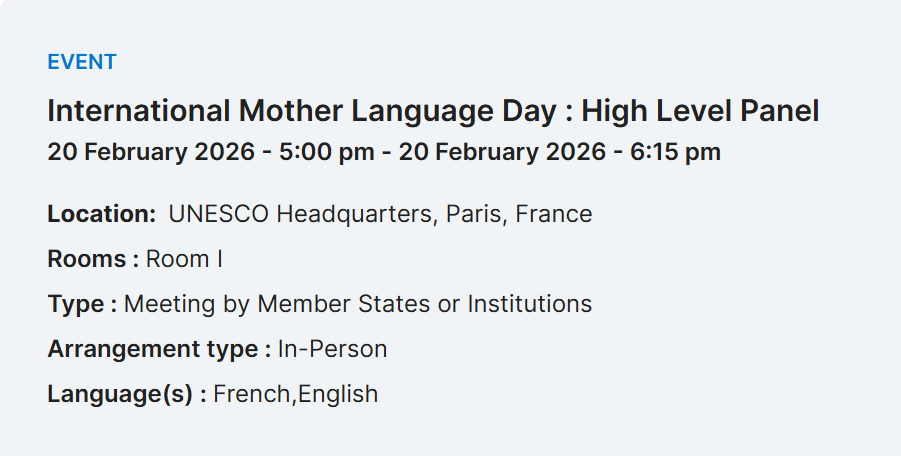
EVENT: On February 21st; The symposium to mark the 26th edition and the International Mother Language Day 2026 will take place from 17:00 pm to 18:30 pm in Room I at UNESCO House (Fontenoy). This year’s edition will highlight the vital role of youth in shaping multilingual education. Language is more than a communication tool. It is key to identity, learning, well-being and social participation and reaffirms the need for education systems that value every learner’s language to foster inclusion and improve outcomes. UNESCO places youth at the heart of this global conversation under the theme “Youth voices on multilingual education.”. The program of the 2026 celebration, organised by the Permanent Delegation of Bangladesh, will feature a high-level panel discussion with opening remarks by H.E. Khondker M. Talha, President of the General Conference, Ambassador, Permanent Delegate of Bangladesh to UNESCO, and H.E. Nasser Hamad Hinzab, President of the Executive Board, Ambassador, Permanent Delegate of Qatar to UNESCO, followed by an address by UNESCO Director-General Prof. Khaled El-Enany. A keynote address by Prof. Damián Blasi on “The future of mother languages in the AI era” will explore how artificial intelligence can either reinforce linguistic inequalities or help revitalize underrepresented languages. A ministerial panel discussion moderated by UNESCO Assistant Director-General for Education Stefania Giannini will examine the role of language in peacebuilding and sustainable development. The evening will conclude with cultural performances (from 7pm to 8:30pm) organized by the Permanent Delegation of Bangladesh, featuring contributions from Member States and celebrating the richness of the world’s linguistic heritage while reaffirming the value of every language. The event is by invitation only. Register to participate!
ACTIVITIES: On February 13th; Ahead of International Mother Language Day, the UNESCO is organizing an online Campus event. Students aged 13–18 can participate, engage via chat, and exchange with international experts and peers from all regions. The activity offers a space for young people to share experiences and identify concrete actions to promote linguistic diversity in their schools and communities. The celebration of the International Decade on Indigenous Languages (2022 – 2032) is emphasizing the role of languages in achieving global development goals.
STATEMENTS: "On this International Mother Language Day, UNESCO is calling for investment in language transmission by placing young people at the heart of the solutions involved. Because linguistic diversity is a pillar of peace, dignity and inclusion. And no voice should be missing from the story of our humanity." Read the full statement of the Director-General of the UNESCO on the International Mother Language Day 2026; February 21st.
PUBLICATION: Languages matter: global guidance on multilingual education published by UNESCO.

PODCASTS: In many countries around the world where it is common practice to use more than one language in daily life, education takes place in multilingual contexts. Yet, many countries adopt monolingual systems of education and see multilingualism – the use of several languages within an area – as a challenge. Listen to the audio-podcasts!
CAMPAIGN MATERIALS: Providing education in only one language that is not necessarily shared by all learners may impact negatively on learning performance, and the development of socio-emotional and foundational literacy skills. Join the IMLD 2026 Campaign "Youth voices on multilingual education.”. Get the communication materials!
How MTB-MLE contributes to Sustainable Development Goal4? The mother tongue-based multilingual education (MTB-MLE) is a realistic and cost-effective way to make significant progress towards SDG 4. Successful pilot projects continue to contribute to transform language policies that respect and encourage the diversity of communities.
You have to speak a language before you can learn to read and write that language (Targets 4.1, 4.4, 4.6 )
Early childhood education of high quality is only possible in the child’s first language (Targets 4.2, 4.5, 4.7)
Well trained and supported multilingual teachers boost learners’ performances (Targets 4.1, 4.5, 4.c)
MTB-MLE enables life-long learning (Targets 4.2, 4.4)
MTB-MLE helps to address gender inequality by allowing girls and women to engage fully in their own learning (Targets 4.1, 4.3, 4.5, 4.6)
Respect for cultural and linguistic diversity leads to peace, social cohesion and sustainable development (Targets 4.5, 4.7)
WHY WE CELEBRATE IT?
Since SDG 4 is so foundational to the other Sustainable Development Goals, without mother tongue-based multilingual education the other 16 goals will remain unachievable. The potential of multilingual education is enormous. However, implementation rarely takes place due to misconceptions surrounding multilingualism. Transforming education entails changing the perception of multilingualism, so that it is seen as an asset for learning in formal, informal and non-formal educational settings. There is growing evidence demonstrating the positive outcomes of multilingual education.
Research shows that education in the mother tongue is a key factor for inclusion and quality learning, and it also improves learning outcomes and academic performance. This is crucial, especially in primary school to avoid knowledge gaps and increase the speed of learning and comprehension. And most importantly, multilingual education based on the mother tongue empowers all learners to fully take part in society.
ACTIONS
Promote the importance of cultural and linguistic diversity, and multilingualism for peaceful and sustainable societies.
Enhance multilingual education as a necessity to transform education in multilingual contexts from early childhood education and well beyond;
Support learning through multilingual education and multilingualism in our fast-changing global contexts and in crisis situations including emergencies contexts;
Revitalize languages that are disappearing or are threatened with extinction.
Sensitize actors in education, teachers, education policy-makers on the transformative power of multilingualism and multilingual education
Support actors in education, teachers, education policy-makers in strengthening of multilingualism and multilingual education
Highlight and share the innovative policies and practices.
PARTNERS
The International Mother language Day is oganized in collobaration with the UNDGACM UNESCO permanent delegations; The UNESCO Institute for Lifelong Learning (UIL); The Asian Development Bank; the Permanent missions of U.N. in new York. With the participation of stakeholders in education, education policy-makers, teachers; Non-governmental organizations, foundations and other bodies supporting multilingualism.
For further information, please contact inclusion@unesco.org

Make a donation.
Invest in children ; Help a child to develop its mother tongues.