PURPOSES: The World Social Justice Day is observed on 20 February to commemorate and urge all efforts to combat unemployment, social exclusion, and poverty. The United Nations General Assembly recognizes that social development and social justice are indispensable for the achievement and maintenance of peace and security within and among nations and that, in turn, social development and social justice cannot be attained in the absence of peace and security, or in the absence of respect for all human rights and fundamental freedoms.
FORUM: "Renewed commitment to Social Development and Social Justice." World Day of Social Justice 2026. The celebration of this day is of particular relevance as it takes place in the aftermath of the Second World Summit for Social Development and the adoption of the Doha Political Declaration. Building on the 2025 theme of strengthening a just transition for a sustainable future, the 2026 commemoration seeks to build on the momentum generated by the World Social Summit and the 64th session of the Commission for Social Development (CSocD64) for advancing social development and social justice through effective policy coordination, equity and inclusion. In 2025, the ILO launched a new report on The State of Social Justice: A work in progress showing major gains in education, poverty reduction and productivity over the past three decades, while entrenched inequalities, fragile trust in institutions and slow progress in key areas continued to hold back social justice worldwide. Key achievements since the first World Social Summit in 1995 include halving the rate of child labour among 5- to 14-year-olds from 20 to 10 per cent, reducing extreme poverty from 39 to 10 per cent, raising primary school completion rates by 10 percentage points, and achieving social protection coverage for over half of the world’s population. At the same time, stark deficits remain. Informality has fallen by only two percentage points in two decades and still affects 58 per cent of workers; the gender labour force participation gap has narrowed by just three percentage points since 2005 and remains at 24 per cent; and trust in institutions has been declining worldwide since 1982. The report stresses the need to place social justice at the core of policymaking – from finance and industry to health and climate – and to strengthen cooperation among governments, international institutions and social partners to deliver coherent responses to global challenges. The findings of the United Nations World Social Report 2025 echoes this call asserting the need for a new global policy consensus to accelerate social progress, anchored in equity, economic security for all, and solidarity. At the Second World Summit for Social Development in Doha, Qatar, Member States of the United Nations demonstrated the political will to deliver social justice and advance social development as a shared global responsibility. The Doha Political Declaration, adopted at the Summit, reaffirms and renews the commitments made in the 1995 Copenhagen Declaration, centring poverty eradication, employment, and social inclusion, as the three critical and interrelated pillars of social development. At the same time, the Doha outcome acknowledges today’s global realities and their impact on social development, from the climate crisis and digital transformation to demographic change. The Doha Political Declaration asserts the need for macroeconomic policies that generate decent jobs and living wages, supported by stronger labour institutions and universal social protection for all, and underlines the need for fair and inclusive transitions in the digital and green economies, and greater investment in the care sector to create quality jobs to meet growing demand for care services. It urges stronger action to promote gender equality, expand opportunities for young people, and help workers and enterprises move from the informal to the formal economy. And, in reaffirming the global commitment to promote inclusive and sustainable economic growth, full and productive employment and decent work for all, it acknowledges the work of the Global Coalition for Social Justice.In outlining the process of follow-up, the Doha Political Declaration reaffirms the Commission for Social Development as the primary platform for and review of the implementation of the Copenhagen Declaration and Programme of Action and the outcome of the Doha Summit. In the first session of the Commission following the Summit, Member States considered the theme, “Advancing Social Development and Social Justice through Coordinated, Equitable and Inclusive Policies”, taking first steps to articulate the policy guidance needed for Doha implementation. Follow the conversations with the hashtags: #20February, #SocialJusticeDay.
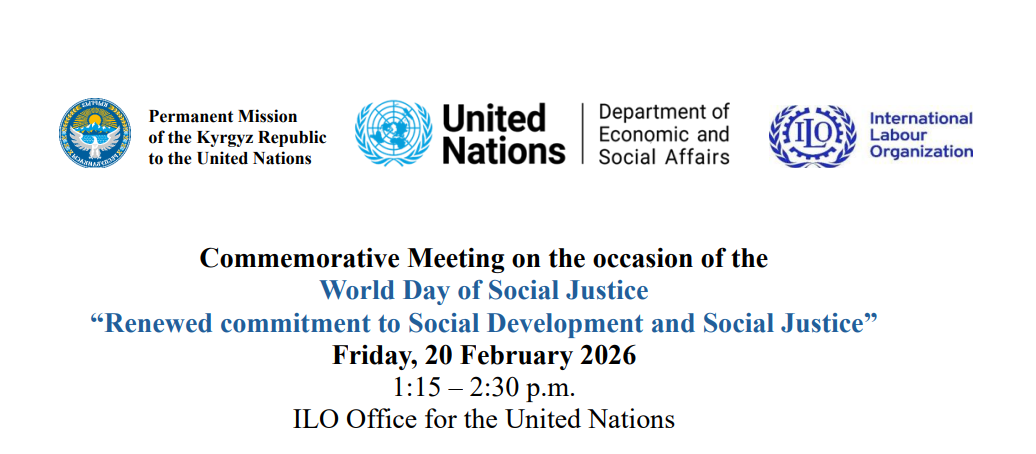
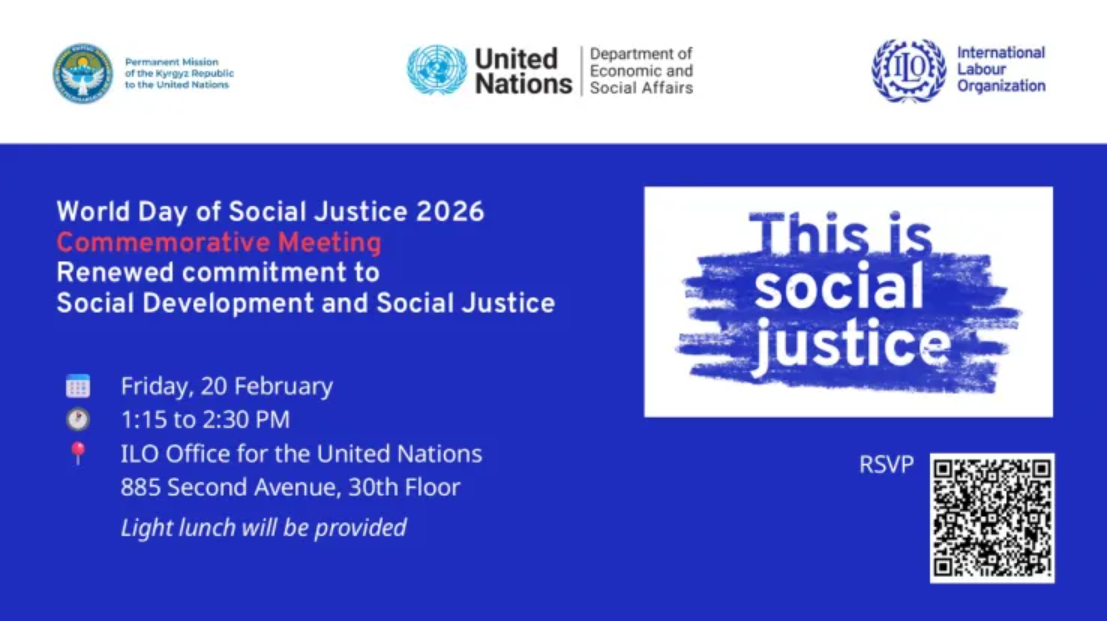
EVENTS: At UNHQ New York; On February 20th, from 01:15 PM. -02:30 PM. (EST); Conference Room 6; The 2026 World Day of Social Justice, convened by the Permanent Mission of the Kyrgyz Republic to the United Nations and the International Labour Organization (ILO), in collaboration with the Division for Inclusive Social Development at the UN Department of Economic and Social Affairs (UN DESA), Within this context, this year’s World Day will focus on “Renewed Commitment to Social Development and Social Justice”. It aims to build on the momentum generated by the Second World Summit for Social Development and the first follow-up session of the Commission for Social Development to advance social justice for all. The event will provide an opportunity to examine how the renewed focus of the multilateral system on social development and social justice can be leveraged to strengthen the social dimension of sustainable development, accelerate the implementation of the Sustainable Development Goals, and promote social justice for all through concrete and actionable outcomes. Guided by the Doha Political Declaration and the deliberations and outcomes of CSocD64, the event will foster forward-looking dialogue on how progress in advancing social justice can be sustained and further strengthened, while addressing persistent and emerging challenges. Particular emphasis will be placed on multi-stakeholder collaboration in advancing shared goals and priorities, and how existing initiatives, such as the Global Coalition for Social Justice, Doha Solutions Platform, and other initiatives showcasing relevant policy and partnerships, can generate political commitments, mobilize investments and deliver concrete action. Register to participate, get the concept note and watch the livestream!
On Friday, February 20th 2026; From 15:00 - 16:00 GMT+1 at ILO Headquarters in Geneva, Switzerland, the event entitled ''From Doha commitment to action for social justice'' will advocate for sustained engagement by governments, social partners, and key stakeholders to advance the commitments outlined in the Political Declaration and through the implementation of the Coalition’s Key Interventions. Watch the event!
Agenda Programme
Opening session by Annalena Baerbock; President, 80th Session of the General Assembly, United Nations (UN).
Keynote intervention: Growth, innovation and social justice by Philippe Aghion; Nobel Laureate in Economics 2025.
Panel discussion: Operationalizing the Doha Declaration through collaboration and collective action
- Colin Jordan; Minister of Labour, Social Security and the Third Sector, Barbados.
- Christine Nkulikiyinka; Minister of Public Service and Labour, Rwanda.
- Datuk Syed Hussain Syed Husman; President, Malaysian Employers Federation (MEF).
- Luc Triangle; General Secretary, International Trade Union Confederation (ITUC).
- Gilbert F. Houngbo; Chair of the Panel discussion and Director-General, International Labour Organization (ILO).
Closing remarks
- Li Junhua; Secretary-General of the Second World Summit on Social Development and Under-Secretary-General for Economic and Social Affairs, United Nations (UN).
INITIATIVES: "Bridging Gaps and Building Alliances". A ground-breaking initiative will be launched to help intensifying collective efforts to urgently address social justice deficits and accelerate the implementation of the 2030 Agenda for Sustainable Development, the Sustainable Development Goals and the Decent Work Agenda. In support of the Global Coalition for Social Justice.
Conferences and summits: This includes the Fourth International Conference on Small Island Developing States, the Third United Nations Conference on Landlocked Developing Countries, the Summit of the Future, as well as preparations for the World Social Summit.
STATEMENTS: Read the Statement of the United Nations Secretary-General on World Day of Social Justice 2026; February 20th and the Statement of the ILO Director General on World Day of Social Justice 2026; February 20th.
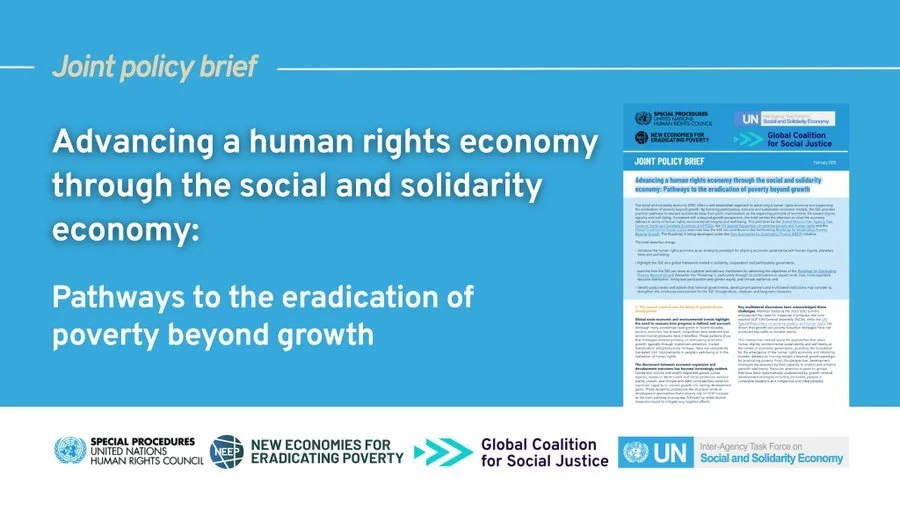
PUBLICATIONS: a new joint policy brief by the UN Inter-Agency Task Force on Social and Solidarity Economy (UNTFSSE), the United Nations Special Rapporteur on extreme poverty and human rights and the Global Coalition on Social Justice explores how the social and solidarity economy (SSE) can advance a human rights economy & support poverty eradication beyond growth.
Social Security for All. Investing in social justice and economic development, produced by the ILO, Social Security Department. English, in French, in Spanish.
A fair globalization: Creating opportunities for all, produced by the ILO - Using worldwide expertise, examines the various facets of globalization, the diversity of public perceptions of the process, and its implications for economic and social progress. Proposes a series of coordinated measures across a broad front to improve governance and accountability at both national and international levels. These include fairer rules for international trade, investment, finance and migration, which take account of all interests, rights and responsibilities; measures to promote core labour standards and a minimum level of social protection in the global economy; and new efforts to mobilize international resources to raise capabilities and meet the Development Goals. Maps out the priorities for national, local and regional policies which can empower people to participate effectively in the opportunities of globalization. Content also available in: español and français;
PODCASTS : More than 60% of the world's employed population, that is 2 billion women, men and youth, earn their livelihoods in the informal economy. Informal workers often lack any form of social protection and are twice as likely to be poor compared to formal workers. Most enter the informal economy not by choice, but due to lack of opportunities. Without concerted action to encourage a transition to formal employment, social justice will not be fulfilled. Listen to the audio-podcasts!
CAMPAIGN MATERIALS: Join the World Day of Social Justice 2026 campaign "Renewed commitment to Social Development and Social Justice."to put social justice at the centre of international, national and regional policy agendas. Get the communication materials!
WHY WE CELEBRATE IT?
Background and Global Challenges: As we face persistent global challenges – geopolitical instability, economic uncertainties, and the climate crisis – it's imperative to address longstanding challenges in our systems. These challenges exacerbate structural inequalities, pushing millions further behind. In 2023, labour markets showed surprising resilience despite economic downturns. Yet, recovery remains uneven, with new vulnerabilities eroding prospects for social justice. The need to bridge gaps and build alliances is therefore increasingly crucial. Moreover, labour market outlook and global unemployment will both worsen with an extra two million workers expected to be looking for jobs in 2024, raising the global unemployment rate from 5.1% in 2023 to 5.2%. As the ILO points out in its latest World Employment and Social Outlook report, as of 2023:
241 million workers lived in extreme poverty.
423 million workers lived in moderate poverty.
These alarming numbers underscore the urgent need for concerted efforts to address the root causes of working poverty and boost economic opportunities globally.
Let's amplify the call to action for greater equality in the world. Together governments, employers and workers can shape a path for a #futureofwork with social justice and decent work for all. Join the public lecture entitled “From Justice for the Past to Peace and Inclusi on for the Future: A Development Approach to Transitional Justice.” Join the celebration by following the hastags #SocialJusticeDay.
ACTIONS
Increase understanding of multiple global challenges and related social justice deficits.
Propose concrete actions to achieve international development goals, including through a new global social contract.
Around the world, as structural issues impair the creation of decent jobs:
Governments must strengthen domestic economies through initiatives to raise productivity growth and living standards.
Utilize international cooperation instruments to foster regional productivity initiatives.
Make better use of multilateral development funds and expedite support to the most fragile economies.
This includes a whole-of-society approach to education and learning thus unlocking their transformational potential as a source for personal dignity and empowerment and a driving force for the advancement of social, economic, political, and cultural development. Additionally, it will be imperative to ensure responses from multiple policy levers spanning economic, social and environmental dimensions, particularly in tackling key transitions of jobs and social protection. As Member States negotiate key considerations for SIDS4, LLDC3, the Summit of the Future and World Social Summit, it is vital that we live up to the pledge of the Copenhagen Declaration to making the eradication of poverty, the goal of full employment and social justice overriding objectives of development.
PARTNERSHIPS
The World Day of Social Justice is organized in Partnerships with the UNDGACM, the United Nations Department of Social Affairs (UNDESA); International Labour Organization (ILO).the United Nations Development Programme (UNDP) and the Permanent Missions of the United Nations.
To mark World Day of Social Justice, UNDP asked four Generation17 young leaders to share their thoughts and experiences in relation to this key development priority. From Mali to Brazil, from South Korea to Argentina, issues of social justice sit at the core of these young leaders’ expertise, purpose and work, as they are inextricably linked to the causes of the many complex development challenges that UNDP and partners, including youth, work to address.
Learn more about:
The World Employment and Social Outlook: Trends 2025 & Trends 2024.
The Social Justice in an Open World: The Role of the United Nations.
The Achievement of social justice.
The report of ILO Director-General to the International Labour Conference 2024.

Make a donation.
More than 45000 boys and girls were released from detention during the ... and restricted access to essential social and justice services.