
PURPOSE: World Hearing Day is held on 3 March each year to raise awareness on how to prevent deafness and hearing loss and promote ear and hearing care across the world. Globally over 430 million people experience disabling hearing loss, a number that could grow to nearly 700 million by 2050. When unaddressed, hearing loss poses a significant challenge for all age groups, hindering language development, communication, cognition, and limiting access to education, employment and social interactions. Raise awareness and promote equitable access to ensure ear and hearing care for all.
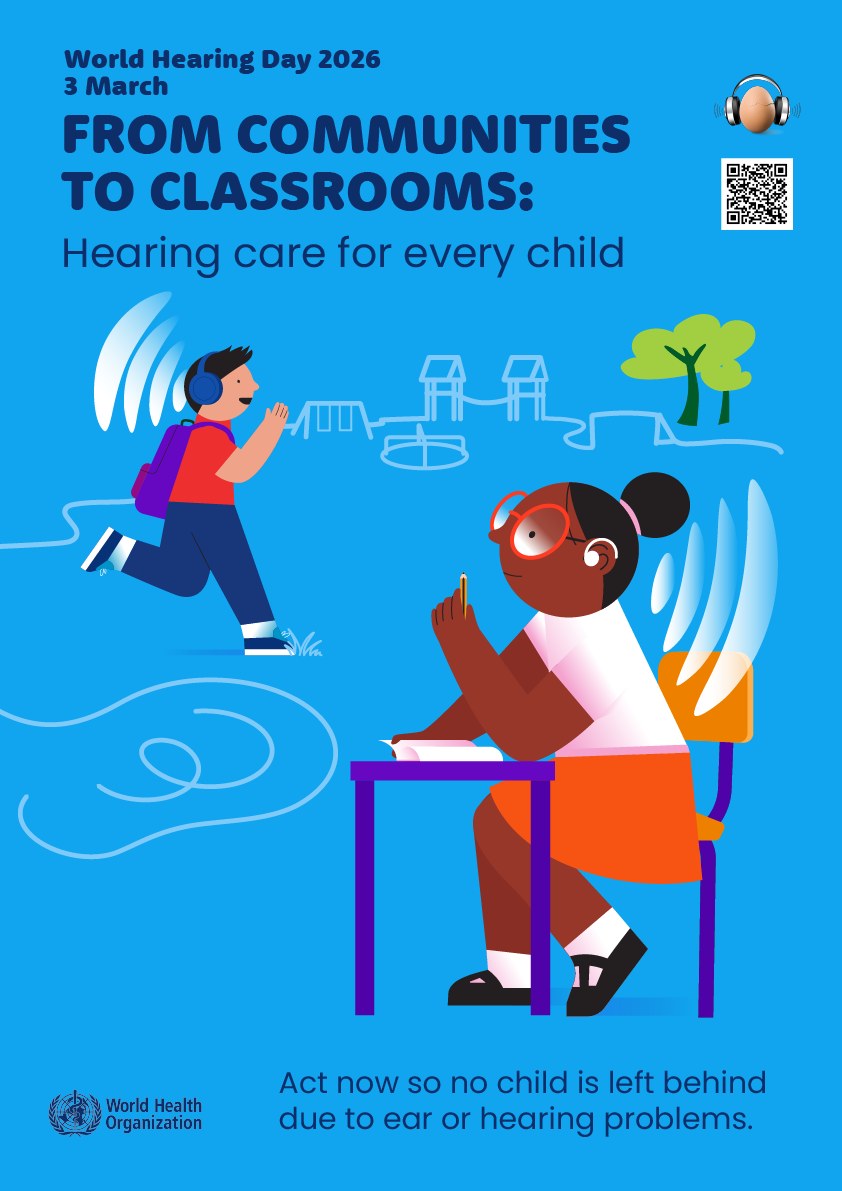
FORUM:“From communities to classrooms: hearing care for all children.” World Hearing Day 2026. This year’s theme campaign focuses on two imperatives: (1) Preventing avoidable childhood hearing loss by Ensuring early identification of and care for children with ear or hearing problems. and (2) Schools and communities are natural entry points to reach children, parents, and teachers. By integrating hearing care into school health and child health programmes, we can help children hear, learn, and succeed. Around 90 million children aged 5-19 years, live with hearing loss. Over 60% of childhood hearing loss is preventable through simple, cost-effective public health measures. Among those living with ear diseases or hearing loss, early identification and care are crucial to prevent long-term impacts on development, education, and future opportunities. Integrating systematic screening and early intervention programmes into school health and child health plans can ensure improved outcomes for children living with ear or hearing problems. Globally, over 80% of ear and hearing care needs remain unmet. Unaddressed hearing loss poses an annual cost of nearly US$1 trillion globally. Deeply ingrained societal mis-perceptions and stigmatizing mindsets are key factors that limit efforts for preventing and addressing hearing loss. The World Health Organization (WHO) estimates that unaddressed hearing loss poses an annual cost of $980 billion each year. This is the cost incurred due to the impact of hearing loss without rehabilitation access, including productivity losses and social exclusion. Empowered individuals can drive change within themselves and in society at large Join Us, Empower yourself and others by taking steps today to ensure good hearing health throughout life. Follow the conservation with the hashtags: #worldhearingday; #hearingcare. #3march.
EVENTS: On March 3rd, to mark the World Hearing Day 2026; The Member States, partners and stakeholders will organize a webinar to raise awareness in communities, in order to address mis-perceptions around ear and hearing problems and ensure accessible ear and hearing care. The event will mark the launch of the WHO-ITU Global standard for safe listening in video game play and sports and the launch of the School module on smart listening, for inclusion into educational programs. It is an opportunity for all of us to make a difference. As stakeholders, partners, and advocates, we can collectively empower ourselves and others. As part of activities promoting World Hearing Day, the World Hearing Forum (WHF), the World Health Organization (WHO), and the Coalition for Global Hearing Health (CGHH) invite proposals for WHF-CGHH Small Grants for World Hearing Day 2026. Kindly register to participate to events to get global visibility. The event information will be made available to a wider global audience.
EXHIBITS: Changing mindsets is essential to making ear and hearing care accessible.Through this photo exhibition and related stories, the World Health Organization and the World Hearing Forum draws attention to the positive impact of timely identification and management of ear and hearing problems in order to correct existing mis-perceptions and change damaging mindsets.
PUBLICATIONS: This planning guide provides a basic and practical framework for any person or organization interested in observing World Hearing Day to raise awareness and promote ear and hearing care (EHC) at national and community levels across the world. The guide is a resource for those working in the field of ear and hearing care. It has been prepared to provide you with the World Hearing Day branding and key messages and introduce you to the resources for the development of your campaign. Use it to get involved with World Hearing Day and encourage others to join the global campaign. By uniting our efforts, we can help make ear and hearing care a worldwide priority issue. Read the Primary ear and hearing care training manual.
RESEARCH: This paper provides insights into the requirements and expectations of people with hearing loss in engagement with connected devices at home, derived from a questionnaire and a stakeholder workshop, and supported by relevant literature. Whether they like it or not, people with hearing loss may depend on a hearing person or technologies (e.g. hearing aid and voice recognition to text) to communicate and interact with the hearing world. While technology intervention can reduce needs for help from hearing people, it inevitably increases dependency on technologies. This can lead to people with hearing loss feeling out of control, especially when communication technologies do not function as expected, often without any back-up, failsafe or contingency plans. Without reliable technologies – mainstream and/or specialist – to bridge the gap between visual- and voice-based (oral) communications, people with hearing loss are at risk of isolation and exclusion.
Living with Hearing Loss in a Connected Home: White Paper from the UCL Department of Science, Technology, Engineering and Public Policy (STEaPP)
Induced Hearing Deficit Generates Experimental Paranoia: The development of paranoid reactions was investigated in normal people experiencing a temporary loss of hearing. Research from AAAS Science.
Rescue of autosomal dominant hearing loss by in vivo delivery of mini dCas13X-derived RNA base editor; Research from AAAS Science.
PROJECTS: Overview of Global Projects in Specific regions.
STATEMENTS: Read the full Message from the WHO Director-General on World Hearing Day 2026; March 3rd.


PODCASTS: Nearly half a billion people worldwide are in need of ear and hearing care as they experience disabling hearing loss or suffer from ear diseases. Only about 17% of these needs are fulfilled as ear and hearing care services remain inaccessible to the majority of the global population, especially in low and middle-income countries. Deafness and hearing loss: how to be deaf or hard of hearing friendly? Q&A -Listen to the audio-podcasts!
CAMPAIGN MATERIALS: Empower yourself to make ear and hearing care a reality for all, explore the World Hearing Day 2026 action toolkit, the posters and other communication materials will be available in multiple non-UN languages. Get the campaign materials!
WHY WE CELEBRATE THE DAY?
Evidence-based and cost-effective interventions are available to prevent hearing loss, treat common ear diseases, and access rehabilitation services. When these interventions are accessible to all, they have the power to transform the lives of their beneficiaries by improving communication access through hearing assistive technology and services, better education and more opportunities for livelihood.
We celebrate the World Hearing Day to
Advocate for integrating ear and hearing care within primary care.
Raise awareness in communities about the importance of ear and hearing care and encourage them to seek services.
HOW TO GET INVOLVED!
Inform people about the importance of ear and hearing care and encourage them to seek services.
Draw attention of decision makers in governments and civil society groups towards the WHO’s recommendations regarding integration of ear and hearing care into PHC.
Encourage governments to integrate primary ear and hearing care into training programmes for health care providers at primary level.
Call attention of primary level health care providers (health workers and physicians) towards the needs of people with hearing loss and ear disease.
Call on countries and civil society to address mis-perceptions and stigmatizing mindsets related to hearing loss, as a crucial step towards ensuring equitable access to ear and hearing care.
Counter the common mis-perceptions related to ear and hearing problems in communities and among health care providers.
Provide accurate and evidence-based information to change public perceptions of ear and hearing problems.
PARTICIPANTS:
The World Heaing Day is organized by the World Hearing Forum (WHF), the World Health Organization (WHO), the Coalition for Global Hearing Health (CGHH), The WHO TEAM on Sensory Functions, Disability and Rehabilitation.
With the participation of:
Decision makers
Venue managers,
Owners of entertainment venues
General public especially young adults
If you would like to receive updates and information about the World Hearing Day, you can register by sending an email to whf@who.int.

Make a donation.
Help us to prevent deafness, promote ear and hearing care across remotes and rural communities.