PURPOSE: The United Nations General Assembly adopted Resolution A/RES/68/163 at its 68th session in 2013, which proclaimed the 2 November as the International Day to End Impunity for Crimes against Journalists (IDEI). Since then, global commemorations of IDEI serve as a unique opportunity to highlight the threats against journalists and reporters. Such actors, including UN agencies, regional bodies, U.N. Member States, members of the judiciary system, civil society organisations and the media, play a vital role to ensure accountability and bring to justice perpetrators of crimes against journalists and media workers.
FORUM: "Chat GBV: Raising Awareness on AI-facilitated Gender-Based Violence against Women Journalists." International Day to End Impunity for Crimes against Journalists 2025. Ending impunity for crimes against journalists is one of the most important and complex challenges of recent times. It is an essential precondition to guarantee freedom of expression and access to information for all citizens. This year's observance highlights the threats women journalists face in the digital space and the chilling effect this can have on freedom of expression more broadly. Digital transformation has created new opportunities for expression and activism, while also giving rise to heightened risks. Women are particularly impacted by these risks, especially those in public-facing roles such as journalists, politicians, and scientists. They face AI-driven threats, including the spread of gendered disinformation, surveillance, deepfakes and other forms of harassment. This emerging issue, also known as technology-facilitated gender-based violence (TFGBV), has become alarmingly prevalent, particularly with the rise of generative artificial intelligence. “Chat GBV” is a call to action for all stakeholders to tackle Gender-Based Violence (GBV) through various initiatives, including talking about it and proposing solutions, taking advantage of various opportunities such as policy and advocacy forums, as well as on digital platforms themselves. Follow the conversations with the hashtags: #EndimpunityDay, #CrimesAgainstJournalists, #2november, #DefendPressFreedom, #ProtectJournalists.
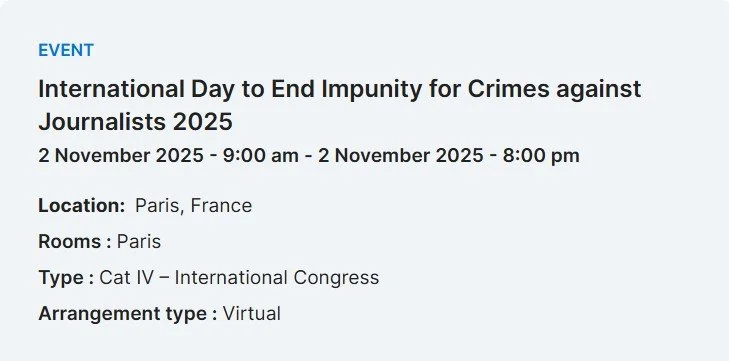
EVENTS: : On November 2nd, the global commemoration of the International Day to End Impunity for Crimes against Journalists 2025 takes place in Paris as a virtual event. Every year, UNESCO, as the coordinator of the United Nations Plan of Action on the Safety ofJournalists and the Issue of Impunity, spearheads the commemoration of the International Day toEnd Impunity for Crimes Against Journalists (IDEI), to create awareness about the dangers that journalists face in informing communities, to hold the memory of journalists that have been killed in their course of their work, and to seek accountability for crimes committed against journalists. The 2025 commemoration is the 11th edition since it was proclaimed in 1993 as the International Day to End Impunity for Crimes against Journalists by the UN General Assembly. Every year’s commemoration is to reinforce the key themes and messages related to the overall fight against impunity and provides an opportunity for stakeholders, including Member States, Civil society, media. and various coalitions, to reaffirm their commitment to the implementation of the UN Plan of Action for Safety of Journalists and the Issue of Impunity. The IDEI 2025 commemoration has also been an occasion for releasing data and highlights of the UNESCO Director-General’s Report on Safety of Journalists every biennium, along with other relevant publications and data. Various stakeholders have also leveraged IDEI as an occasion to raise awareness about the fight against impunity, by engaging in different activities, including holding national/regional events, organizing side-events on the margins of major events, releasing new reports or publishing op-ed articles on major news platforms, making the case for the need for a safer environment for journalists. This multifaceted approach to commemoration has significantly raised awareness of the thematic issues related to impunity and has fostered broader engagement among partners committed to the safety of journalists, in line with the UN Plan of Action on Safety of Journalists and the Issue of Impunity. This year, IDEI will be commemorated with the same approach, but with greater emphasis on encouraging national events worldwide with higher visibility. Hence no global signature event/conference will be held. This approach will enable the upscaling of national events as forms of localized ownership of commemoration and provide an opportunity to contextualize the thematic issues around crimes against journalists and the issue of impunity in local contexts.
Safety of Women Journalists, Artificial Intelligence, and Technology-facilitated Gender-Based Violence.
Digital transformation has created new opportunities for expression and activism, while also giving rise to heightened risks. Women are particularly impacted by these risks, especially those in public-facing roles such as journalists, politicians, and scientists. They face AI-driven threats, including the spread of gendered disinformation, surveillance, deepfakes and other forms of harassment. This emerging issue, also known as technology-facilitated gender-based violence (TFGBV), has become alarmingly prevalent, particularly with the rise of generative artificial intelligence. The 2021 UNESCO-commissioned study The Chilling, carried out by ICFJ, found that 73% of women journalists had experienced online threats related to their work, with one in four facing offline attacks as a result. There has been no relief to this trend since. Rather, access to institutional support still remains scarce, resulting in the following trends:
• Offline violence remains widespread and is increasingly connected with online abuse, erasing the line between digital and physical threats.
• Physical violence, legal threats, including SLAPPs (Strategic Lawsuits Against Public Participation), defamation campaigns, and doxxing, are used to silence women journalists.
• The impact extends beyond individuals, affecting families and sources, leading to self-censorship, social isolation, and mental health struggles.
• The constant threat of online harassment causes many journalists or female content creators to withdraw from public participation.
The celebration of the IDEI 2025 seeks to further address this problem, to reinforce stakeholder’s ongoing work in tackling online attacks against journalists, and particularly in promoting the safety of women journalists, by focusing on online gendered violence under the theme: Chat GBV: Raising Awareness on AI-facilitated Gender-Based Violence against women journalists. This theme addresses the growing threats posed by AI tools that facilitate and amplify online gender-based violence, harassment, surveillance, and gendered disinformation, disproportionately against women journalists. “Chat GBV” is a call to action for all stakeholders to tackle Gender-Based Violence (GBV) through various initiatives, including talking about it and proposing solutions, taking advantage of various opportunities such as policy and advocacy forums, as well as on digital platforms themselves. The purpose is to further reinforce the implementation of the UN Plan of Action on the Safety of journalists and the Issue of Impunity, for which UNESCO plays a coordination role, and in particular as articulated in the various processes, including the Vienna conference consultations on the 10th anniversary of the UN Plan. During this process, one of the key priorities identified was tackling the increasing vulnerabilities of women journalists, particularly in online spaces, where digital technologies including artificial intelligence, are implicated in facilitating these vulnerabilities. Chatting about GBV as part of commemoration of IDEI will allow both right holders and duty bearers, as well as other intermediary actors, to better understand the scope and complexity of the problem in finding durable solutions.
The Global Campaign As part of IDEI 2025, UNESCO will develop a global advocacy campaign on AI facilitated gender-based violence. The campaign will include various communication materials and key messaging highlighting the problem, impact, and call to action against AI facilitated gender-based violence against women journalists. The campaign would be useful in providing data, trends and messaging, which would inform organizing national events. It will be designed based on data from the following processes:
• A new global survey will be conducted on technology-facilitated gender-based violence (TFGBV) to better understand and address the rising threat of online violence against women journalists (as well as human rights defenders, and activists). Disaggregated data on trends and impacts of TFGBV as it relates to women journalists will inform the messaging of the global campaign. The survey is led by UN Women and the International Center for Journalists (ICFJ), in partnership with UNESCO and funded by the European Union under the ACT to End Violence Against Women and Girls programme.
• Data and findings already assembled for the 2025 UNESCO World Trends Report on Freedom of Expression and Media Development.
• Existing data drawn from UNESCO’s relevant prior work, as well as safety of journalists in different countries and crisis context, including Ukraine, Afghanistan, Sudan, Haiti, and Gaza. The Campaign’s key messages and communications materials will be widely shared with stakeholders to inform the preparations for national events.
Register to participate to the Celebrations around the world!
On May 22nd, 2025; At United Nations Headquarters in New York, the United Nations Security Council held a meeting entitled ‘‘Addressing emerging threats, ensuring safety of civilians, humanitarian and UN personnel, journalists and media professionals and enhancing accountability mechanisms" under the agenda item "Protection of civilians in armed conflict" to highlight the issue. The Report of the Secretary-General on the Protection of civilians in armed conflict (S/2025/271) and the Letter dated 7 May 2025 from the Permanent Representative of Greece to the United Nations addressed to the Secretary-General (S/2025/301) have been presented. Watch the livestream!
At UN Geneva, On November 2nd; An event is co-organized by the Office of the United Nations High Commissioner for Human Rights (OHCHR), the International Organizations in Geneva and the United Nations Educational, Scientific and Cultural Organization (UNESCO) will be held in order to celebrate the International Day to End Impunity for Crimes against Journalists 2025. More specifically, it is aimed to consider and underscore the high rate of impunity for crimes against journalists worldwide, especially affecting those working in and on crises and emergencies; highlight the legal factors – from restrictive laws to abusive litigation – which increase that impunity; and share best practices on how to reduce that high rate of impunity.
In Washington D.C; On November 2nd at the headquarters of the Organization of American States (OAS) The commemoration of the International Day to End Impunity for Crimes against Journalists 2025 will take place, Organized by UNESCO, in partnership with the Secretary General of the Organization of American States (OAS), the Inter-American Commission on Human Rights (IACHR) and its Office of the Special Rapporteur for Freedom of Expression (RELE), the event will focus on the violence against journalists, the integrity of elections, and the role of public leadership. This important event will include multiple panels and discussions, bringing together a diverse group of stakeholders including former special rapporteurs, academia, civil society organizations, states, United Nations agencies, and any other individuals dedicated to improving journalist safety worldwide. The day will furthermore commemorate the 27th anniversary of the establishment of the OAS Special Rapporteurship and celebrate the 32th anniversary of the United Nations Special Procedure, two specialized offices that hold a pivotal role in promoting and safeguarding freedom of expression globally.
Commemorations Around the world: Discover the events in your area.
STATEMENTS: Read the Statement of the United Nations Secretary-General on the International Day to End Impunity for Crimes Against Journalists 2025; and the Statement of the UNESCO Director-General on the occasion of the International Day to End Impunity for crimes against journalists 2025; November 2nd.
PUBLICATIONS: UNESCO Director-General's Report on the Safety of Journalists and the Danger of Impunity.


PODCASTS:The IDEI commemoration is a call to honor the courage and commitment of journalists killed in the exercise of their profession; and to reaffirm the importance and urgency for States and other stakeholders, to deploy their maximum efforts to generate an environment free of violence for the press, as well as the necessary conditions for them to carry out their work freely, independently and safely. Listen to the audio podcast!
CAMPAIGN MATERIALS: Join the campaign to ‘‘End Violence against journalists, ensure the integrity of elections, and to enhance the role of public leadership.“ Get the communication materials!
WHY WE CELEBRATE THE DAY?
HOW TO GET INVOLVED?
PARTNERSHIPS
It is in recognition of the far-reaching consequences of impunity, especially of crimes against journalists, that the United Nations General Assembly adopted Resolution A/RES/68/163 at its 68th session in 2013 which proclaimed November 2nd as the ‘International Day to End Impunity for Crimes against Journalists’ (IDEI). The Resolution urged Member States to implement definite measures countering the present culture of impunity. The date was chosen in commemoration of the assassination of two French journalists in Mali on 2 November 2013.
Impunity leads to more killings and is often a symptom of worsening conflict and the breakdown of law and judicial systems. UNESCO is concerned that impunity damages whole societies by covering up serious human rights abuses, corruption, and crime. Governments, civil society, the media, and everyone concerned to uphold the rule of law are being asked to join in the global efforts to end impunity.
Honour the 1,200 journalists have been killed around the world between 2006 and 2020, over.
Highlight the to 9 out of 10 cases of these killings which remain judicially unresolved, according to the UNESCO observatory of killed journalists.
Maximining local impact with national commemorations around the world.
As part of commemorations, the UNESCO network of field offices and other UN agencies, civil society organizations, Member States, Intergovernmental organizations, media associations, as well as other key actors, will be invited to join hands in initiating local/national events which will be assembled in a global map. The number of local events has been increasing every year, pointing to increased awareness at national level, and willingness to take the lead in contributing to the fight against impunity. National-level commemorations will foster and build on this growing momentum and national ownership, particularly in countries where the safety of women journalists is an issue of particular concern, and where UNESCO is already actively engaged through programming, partnerships, or policy support. UNESCO will prepare and share resources and thematic guidance, including data from the survey, trends and key messages to various actors to facilitate their engagement in the commemoration.
What partners and strategic coalitions on safety of journalists can do to commemorate IDEI.
Partners and coalitions on the safety of journalists will be encouraged to actively engage in amplifying this year’s theme through various actions and partnerships specific to their mandates or in partnership with other actors with shared goals. In order to adopt a process-oriented approach that goes beyond commemoration events, partners will be encouraged to take advantage of the occasion to do initiatives such as issuing a public statement, announcing a major policy reform initiative, or a new project on safety of journalists. The following suggestions could further inform the planning of stakeholders in preparations for IDEI.
The International Day to End Impunity for Crimes against Journalists’ is held by the United Nations Security Council, the UNESCO regional offices, the Office of the high commissioner for Human Rights (OHCHR), the Special Rapporteur on the promotion and protection of the right to freedom of opinion and expression, the Reham al-Farra Memorial Journalism Fellowship, the The Committee to Protect Journalists, the Amnesty International; Human Rights Watch (HRW); With the participation of the Civil Society Organization, Non-Governmental Organizations, Journalits, editors, Reporters and academia.