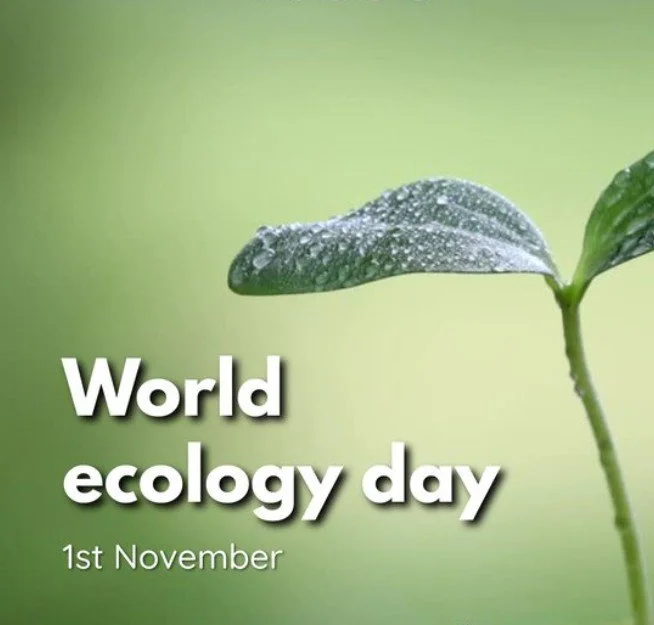
PURPOSE: The United Nations General Assembly designated November 1st as World Ecology Day. Ecology is the study of how living organisms like plants, animals, and humans interact with each other and their environment. The observance aims to spotlight ecological sciences and to address the legal, ecological, and socio-economic aspects of drought by bringing together experts, government representatives, and international stakeholders to discuss proactive measures for wildfire prevention and management.
FORUM: “The relationships between water and conflict.” World Ecology Day 2025. Analysis finds that rainfall seasonality tends to act as a risk multiplier rather than a core driver of conflict. This year we will focus on the divergent relationships between water and conflict. Studies finds that conflict death rates are 50% higher in places where water stress is rising owing to heightened rainfall seasonality. Ecological Scientists highlights how there have been no interstate wars fought over water in the modern era. In this regard, the hundreds of active freshwater treaties around the world demonstrate that strategic cooperation is effective when the downside risks are well-known, similar to nuclear non-proliferation treaties. There are 263 international river basins globally with billions of people dependent on them for their freshwater. Their stability is paramount for both food security and international peace. Popular narratives have warned of looming “water wars”, especially in transboundary river and lake basins. The importance of these systems is underscored by the 157 international freshwater treaties signed between countries in the second half of the 20th century, highlighting that countries understand the cataclysmic consequences of mass disruption to freshwater and food supplies. This cooperative approach to water management in some ways mirrors the restraint that has characterised the use of nuclear weapons over the past 80 years. As with weapons of mass destruction, threats to water supplies have the potential to lead to societal collapse. As a result, mutual vulnerability and the threat of catastrophic destruction has encouraged pragmatic collaboration. Let’s discuss and assess how human communities interact with the natural environment – specifically in relation to resource scarcity, climatic changes, and the ways population growth amplifies existing strains. Follow the conversations with the hashtags: #worldecologyday, #1november, #ecology, #ecologicalsciences,
EVENT: On November 1st, from 1:15 PM to 2:45 PM EDT, an event to mark World Ecology Day 2025 will be held to Strengthen the international community’s commitment to the 2030 Agenda for Sustainable Development by focusing on Goals 13 (Climate Action), 15 (Life on Land), and 17 (Partnerships for the Goals). This event serves as a call to action for governments, civil society, and religious organizations to join forces in confronting the ecological crisis and securing a sustainable future for all.
ACTIVITIES: Help your learners explore ecology with a fun, hands-on eco web activity!
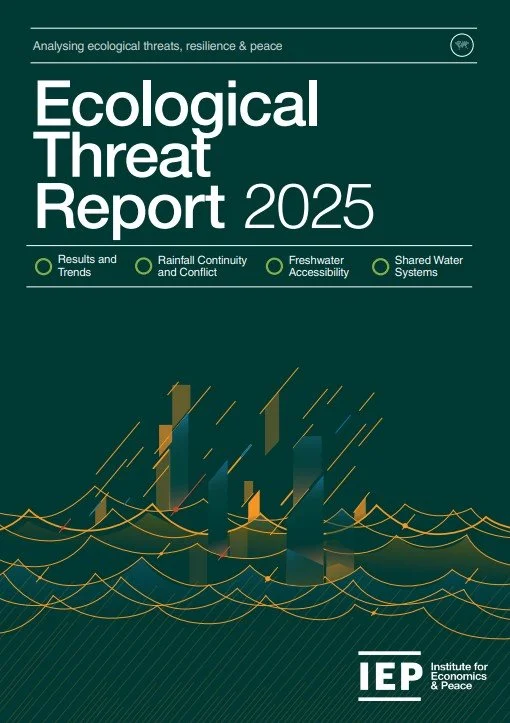
PUBLICATIONS: The Ecological Threat report 2025 (ETR) published by the Institute for Economics and Peace is a comprehensive, data-driven global assessment of ecological risks. It covers 3,125 sub-national areas in 172 countries and territories, representing more than 99 per cent of the world’s population. It measures four interlocking threats: water risk, food insecurity, the impact of natural events, and demographic pressure. The broader takeaway from the report is twofold. First, water stress between countries has historically been more likely to foster diplomacy than war, particularly when institutional frameworks are in place. Second, as rainfall variability intensifies, so does conflict; therefore, the advantages of adaptive cooperation become more important. Improving micro water capture, flexible allocation rules, and mechanisms that spread costs and benefits can prevent disputes from escalating while sustaining the economies that depend on rainfall.Precipitation patterns are shifting, and the seasonality of rainfall is increasing. Seasonality refers to the concentration of rainfall into fewer months within the year, resulting in wet seasons becoming wetter and dry seasons becoming drier, even though total annual rainfall may not change. This is occurring in over 60 per cent of the areas covered in the report, with the remainder recording a more even spread of rain throughout the year. In areas experiencing severe increases in rainfall seasonality, there are on average four times as many conflict deaths as in places where it is relatively stable or has notably decreased. Analysis finds that rainfall seasonality tends to act as a risk multiplier rather than a core driver of conflict. These heightened risks are particularly acute where ecological fragility overlaps with rapid population growth and already-low rates of freshwater access. Sub-Saharan Africa is the most critically affected area, with per capita water usage having fallen from 113 cubic metres per person in 2000 to 89 as of 2022, less than one-fifth the global consumption rate. When populations expand quickly, governance is weak, and there is a history of conflict and group grievances, rainfall shocks are more likely to generate competition over land, water, and food – and therefore violence. Modelling finds that when population growth exceeds roughly two to three per cent annually, heightened seasonality can add as many as six additional conflict deaths per year for every 100,000 people. Read the full report!
Read also the Journal of the Ecological Society of America.
PODCASTS: We present contributory citizen science as a valuable method to scientists and practitioners within the environmental and ecological sciences. Listen to the audio-podcasts!
CAMPAIGN MATERIALS: Let’s develop and implement new technologies to assess and treat soil, water, air, plant, animal, and energy resource concerns Get the communication materials!