PURPOSE: The UNESCO celebrates World Philosophy Day each year, on the third Thursday of November in order to bring philosophy, that universal language of thought, into service in order to identify all the ramifications of the crisis and to clear a common path for humanity and to underline the enduring value of philosophy for the development of human thought, for each culture and for each individual. Various methods in philosophy give particular importance to intuitions, i.e. non-inferential impressions about the correctness of specific claims or general principles. For example, they play an important role in thought experiments, which employ counterfactual thinking to evaluate the possible consequences of an imagined situation. These anticipated consequences can then be used to confirm or refute philosophical theories. The method of reflective equilibrium also employs intuitions. It seeks to form a coherent position on a certain issue by examining all the relevant beliefs and intuitions, some of which often have to be deemphasized or reformulated in order to arrive at a coherent perspective. The Pragmatists stress the significance of concrete practical consequences for assessing whether a philosophical theory is true or false. Experimental philosophy is of rather recent origin. Its methods differ from most other methods of philosophy in that it tries to answer philosophical questions by gathering empirical data in ways similar to social psychology and the cognitive sciences.
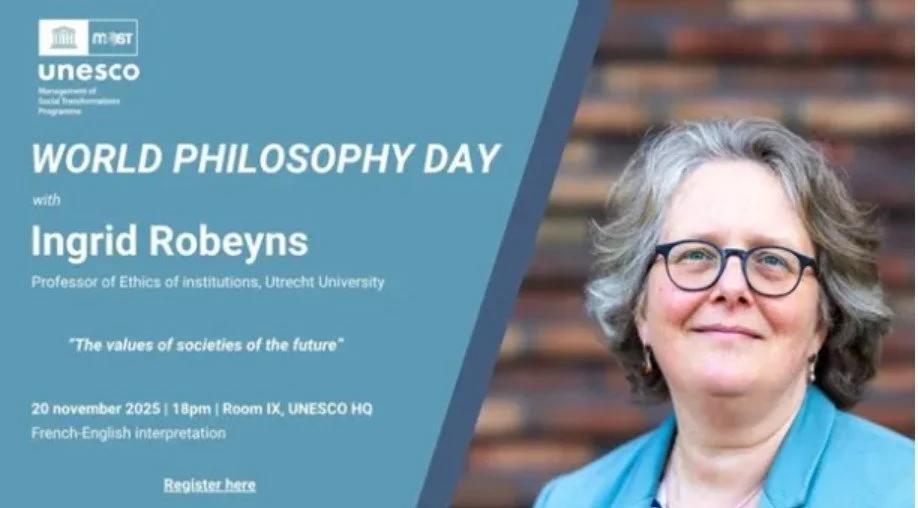
FORUM: "The Values of Societies of the Future." World Philosophy Day 2025. The celebration will start with a keynote by Prof. Ingrid Robeyns on the ethics of inequality and values shaping future societies. Trained under Nobel laureate Amartya Sen, Prof. Robeyns combines rigorous economic analysis with philosophical inquiry to explore the moral dimensions of social and economic institutions and the outcomes they generate. Her most recent book, Limitarianism: The Case Against Extreme Wealth (Allen Lane and Astra, 2024), advances a powerful argument for limiting excessive wealth as a condition for justice, democracy, and sustainability. After decades of research on human development and the capability approach, she now leads a team investigating the values and moral principles underlying different socioeconomic systems. In 2025, she was awarded the Stevin Prize, the highest academic distinction in the Netherlands. In her keynote lecture, Prof. Ingrid Robeyns will reflect on the urgent need to rethink the moral and institutional foundations of our societies in the face of deepening inequality, democratic erosion, and accelerating climate crisis. Prof. Robeyns will argue that humanity now stands at a civilizational crossroads, leaving behind an unsustainable model of development without a clear moral compass for what should follow. Drawing on her recent work on Limitarianism and her broader research on the ethics of institutions, she will examine the values and principles that could underpin alternative socioeconomic systems — systems that prioritize human flourishing, solidarity, and ecological responsibility. By exploring possible future scenarios, she will invite policymakers, scholars, and citizens alike to consider what kinds of societies we want to build, examining the values and moral principles they stand for, the foundational assumptions on which they rest, and which groups would benefit most if they were to become the societies of the near future. Follow the conversation with the hahstags: #thinkers, #philosophers ,#thevaluesofsocietiesofthefuture,#WorldPhilosophyDay, #philosophy,#Philosophicaldebates, #PhilosophyDay.
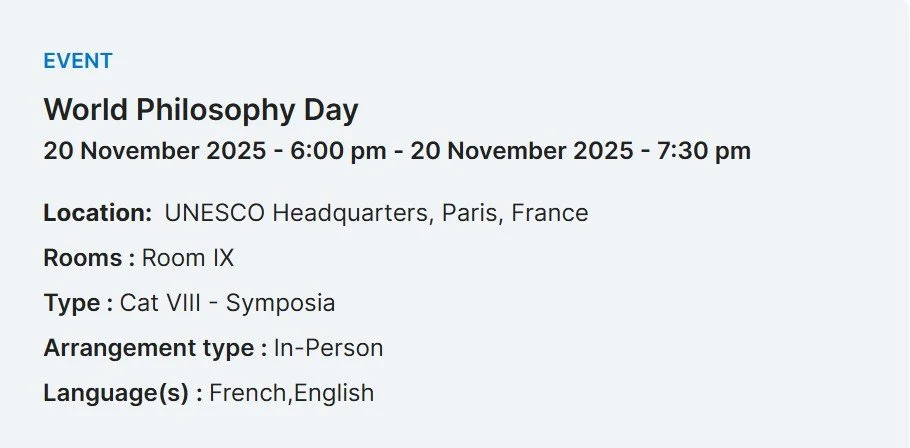
EVENTS: On November 20th, from 6:00 pm to - 7:30 pm will be held a symposium to mark the World Philosophy Day 2025 at UNESCO Headquarters, Paris, France in the Room IX. A keynote address will be delivered by Professor Ingrid Robeyns, a Belgian-Dutch philosopher and economist who holds the Chair in Ethics of Institutions at Utrecht University. The celebration of the World Philosophy Day 2025 will initiate a dialogue on the ethics of inequality and the values shaping future societies. This event supports the UNESCO MOST Programme’s mission to help policymakers rethink prevailing socio-economic paradigms, inspiring action toward just, inclusive, and sustainable societies. This year’s event will build on the discussions started through the Thought Leadership Series, which has brought together leading thinkers in the Social and Human Sciences throughout 2025 to explore critical societal challenges and innovative solutions. World Philosophy Day will deepen this conversation by examining the moral limits of wealth and the ethical principles guiding alternative socioeconomic futures. Register to participate and Follow the celebration online
LIVESTREAM: Philosophical Debates held to mark World Philosophy Day 2025.


PODCASTS: The humanities and philosophy deal not only with the traditional legacy derived from past cultures and times but also with the challenges the world is currently facing: the plurality of identities, languages, migration, environmental change, critical thinking on theory, action, and policies. Listen to the audio-podcasts!
CAMPAIGN MATERIALS: Engage substantive long term reflection was indispensable to our societies in steering the environmental, technological, and cultural dynamics that are transforming them. A new vision for the humanities in the 21st Century. Get the communication materials!
WHY WE CELEBRATE THE DAY?
HOW TO GET INVOLVED!
PARTNERSHIPS
The World Philosophy Day is hosted by the UNESCO, the UNESCO Regional Offices, The Management of Social Transformations (MOST) Programme, the International Council for Philosophy and Human Sciences (CIPSH) , the Harvard University Department of Philosophy; the Stanford University Department of philosophy; the Oxford University, the Columbia University Department Of Philsophy and many others. With the participation of philosophical societies philosophers and scientists from all branches of natural and social sciences, educators, teachers, students, press journalists and other mass media representatives, and the general public.
Highlight the value of philosophy for the development of human thought
Stimulate intercultural dialogue.
Embrace hundreds of learned societies in the field of philosophy, human sciences and related subjects.
Invite people to discover the diversity of the intellectual currents in the world
Organize various types of activities - philosophical dialogues, debates, conferences, workshops, cultural events and presentations around the general theme of the Day
World Philosophy Day belongs to everyone, everywhere, who cares about philosophy. Many philosophical debates that began in ancient times are still debated today; Philosophy goes where hard science can't, or won't. As an antidote, UNESCO works daily to bring philosophy, that universal language of thought, into service in order to identify all the ramifications of the crisis and to clear a common path for humanity. UNESCO leads World Philosophy Day – but does not own it