PURPOSE: More than 30 years ago, the United Nations General Assembly took an important step in promoting the idea that everyone deserves a decent place to live by declaring that the first Monday in October would be World Habitat Day. Every year, UN-Habitat recognizes the basic right of everyone to adequate shelter and asks everyone to join together as one global network in communicating the message can remove barriers to opportunity, health and success that might have been part of a family’s life for years, and in many cases for generations. The aims of the day is to focus on shelter provision, to highlight the plight of the homeless, leadership in post conflict reconstruction, and developing and improving the human settlements and the quality of urban life.
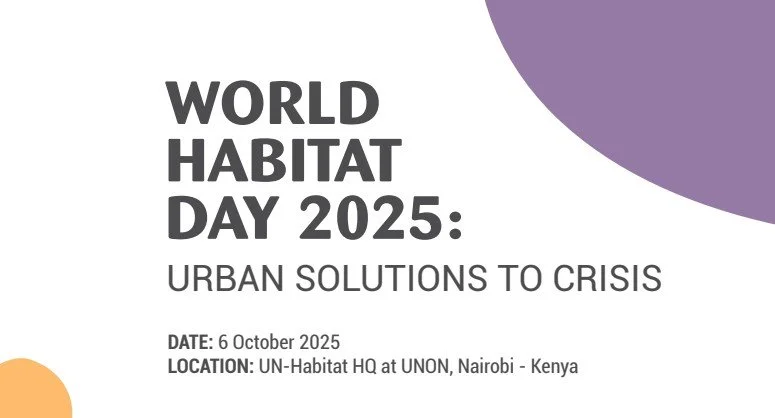
FORUM: "Urban Crisis Response.'' World Habitat Day 2025. An increasing number of people are driven from their homes by crises such as conflict, political instability, climate change and economic hardship. A record 122 million people are forcibly displaced1 . In an increasingly urbanizing world, displacement is becoming an urban phenomenon. Over 60% of internally displaced persons, refugees, and migrants are seeking refuge in cities, putting pressure on local systems. This is accelerating urban growth while changing territories significantly. This makes urban crisis response and urban displacement a timely focus for World Habitat Day. The day will highlight sustainable, scalable, and transformative solutions to urban displacement that help stabilize populations while promoting prosperity and fostering social cohesion for all. It will put the spotlight on the importance of urban and territorial planning, inclusive urban governance and the role of local governments in sustainable solutions for displacement. MOVING FROM ACUTE CRISIS RESPONSE TO SUSTAINABLE SOLUTIONS: A humanitarian response that fails to integrate development approaches early, risks prolonging the crisis and aid dependency. There is an urgent need to pivot earlier towards development- and government-led solutions in dealing with displacement situations for more durable outcomes. To effectively transition to sustainable urban solutions and promote self-reliance, three approaches are key: (1) First, inclusive approaches to urban and territorial development with social cohesion at the center are key to addressing the needs of both host communities and the displaced. In line with SDG 11 and the New Urban Agenda, inclusive urban planning and urban governance are essential tools to facilitate social cohesion and integration of displacement of affected communities. (2) Second, sustainable solutions also need to ensure access to adequate housing, land, and basic services. Displaced populations and host communities, particularly the urban poor, often face acute challenges in access to adequate housing, basic services, and economic opportunities. The ever-worsening global housing crisis exacerbates these challenges, as it strains already limited resources. The influx of more displaced persons strains urban systems even more, and if unplanned, further fuels informal settlements and slums where 1.1 billion people already reside globally. Third, Mayors and local governments have demonstrated over and over again that they can drive solutions, working closely with the displacement of affected communities in all their diversity. Their leadership is key to ensure social cohesion as a prerequisite for inclusive growth and stability. Enhancing multi-level governance, building local governments’ capacity, and ensuring enabling legal and policy instruments, along with comprehensive financing solutions, are critical in achieving long-term solutions for both host and displaced communities and provides them with access to adequate housing. The World Habitat Day is marked on the first Monday of October each year and is recognized by the United Nations to reflect on the state of towns and cities, and on the basic right of all to adequate shelter. Follow the converstions with the hashtags: #WorldHabitatDay, #UrbanOctober, #urbancrisisresponse, #Right2Housing, #MindtheGap, #LeaveNoOneBehind, #adequatehousing.
EVENTS: On October 6th, From the UN-Habitat HQ at UNON, Nairobi; Kenya, the Global Observance of World Habitat Day 2025 will be linked to, urban crisis response. The theme will focus on addressing multiple crises affecting urban areas, including climate and conflicts that are contributing to inequality, and promote existing tools and approaches to effective crisis response. In line with UN-Habitat’s Strategic Plan 2026–2029, the World Habitat Day will: 1. Share urban and territorial development strategies for durable solutions to displacement. 2. Recognize the central role of local governments in championing solutions and the need for multi-level governance. 3. Highlight social cohesion and inclusive governance as key enablers of urban integration of displaced populations. 4. Consider the critical role of housing, land and basic services for sustainable solutions for displacement. 5. Showcase urban practices that have successfully achieved social cohesion, recovery and integration for displacement of affected communities. Read the Concept Note, the participants information, the agenda programme and Watch the World Habitat Day 2025 livestream!
SCROLL OF HONOUR: UN-Habitat is pleased to announce the winners of the 2025 UN-Habitat Scroll of Honour Award, recognizing outstanding contributions to sustainable urbanization and the improvement of urban life worldwide. Established in 1989, the Scroll of Honour is one of the most prestigious awards in the field of sustainable urban development. This year’s winners were selected from 141 nominations spanning Africa, Asia, Europe, and the Americas. Their initiatives showcase best practices and innovative solutions targeting the most vulnerable and advancing Sustainable Development Goal 11: Sustainable Cities and Communities. The awards were presented today on World Habitat Day, observed annually on the first Monday of October. This year’s theme, “Urban crisis response,” highlights the urgent need for cities to respond to overlapping challenges, from housing insecurity to climate shocks. The ceremony took place at the UN-Habitat headquarters in Nairobi, Kenya. As urban challenges intensify worldwide, this year’s Scroll of Honour winners highlight how innovative solutions – from housing rights to food security and inclusive public spaces – can make cities more resilient, inclusive, and sustainable.
The 2025 UN-Habitat Scroll of Honour Award winners are:
Israel Smart, Jos Plateau, Nigeria – for his transformative “Hydroponic Farm-in-a-Box,” a solar-powered, circular farming innovation built from recycled plastics that tackles food insecurity, unemployment, and plastic pollution while empowering women and youth.
Public Works Studio, Beirut, Lebanon – for its pioneering “Housing Monitor” initiative, the first platform in the South West Asia and North Africa region enabling vulnerable residents to report eviction threats and access legal and social protection, while advancing housing rights and spatial justice.
Just a Change, Lisbon, Portugal – for its volunteer-driven housing rehabilitation model, restoring unsafe homes across Portugal and bringing dignity, safety, and sustainability to vulnerable families through inclusive, community-based action.
Clara Marina Brugada Molina, Mexico City, Mexico – for her visionary “UTOPIAS” model of urban regeneration, reclaiming neglected public spaces to create inclusive hubs for culture, health, education, and care, rooted in equity and community participation.
In addition, a Special Citation was awarded to Gangwon State (IUTC), Republic of Korea, for strengthening global capacity for sustainable urban development through training and international collaboration.
PUBLICATION: The UN-Habitat’s Strategic Plan 2026–2029 is a bold response to the global housing crisis, which affects nearly 2.8 billion people worldwide. Read the full Strategic Plan!
STATEMENTS: “From inclusive housing models to circular food systems, each of the recognized initiatives demonstrates that even in times of crisis, cities can respond with solutions that are inclusive, sustainable, and transformative,” said Anacláudia Rossbach, Executive Director of UN-Habitat.
Read the statement of the United Nations Secretary-General on World Habitat Day 2025, the Message from the President of the United Nations Habitat Assembly on World Habitat Day 2025 and the message of UN-Habitat Executive Director on World Habitat Day 2025, October 6th.

PODCASTS:.Adequate housing, secure land tenure, and access to basic services are critical for recovery, enabling families to return, reintegrate, and rebuild their lives. According to the UN-Habitat’s World Cities Report, Solutions to Tackle urban poverty and inequality have become an urgent global priority. Listen to the audio-podcasts!
CAMPAIGN MATERIALS: Millennials and Gen Z are the driving force behind sustainable urban development, and their leadership is crucial in addressing today’s challenges. This year, we urge action to strengthen local leadership, build resilient urban systems, and make sure no one is left behind in times of crisis. Join the Campaign “Urban Crisis Response.” and Get the communication materials!
WHY WE CELEBRATE THE DAY?
HOW TO GET INVOLVED!
PARTNERSHIPS
The World Habitat Day is Hosted by the United Nations Human Settlement Programme (UN-HABITAT), the United Nations Department of Economic and Social Affairs (UNDESA), the UN-Water, the UN-Energy, the United Nations Human Rights, the Special Rapporteur on the Right to Adequate Housing, the Habitat for Humanity.
With the participation of Civil society Organizations, Non-Governmental Organizations, Mayors of Cities, Urban Planners, Researchers and academicians.
Please feel free to contact us by email address: unhabitat-whd@un.org
Held on the first Monday of October and during the launch of Urban October, the World Habitat Day is observed all around the world. While the right to adequate housing is enshrined in article 25.1 of the Universal Declaration of Human Rights (1948) and in article 11 of the 1966 International Covenant on Economic, Social and Cultural Rights (ICESCR) and other international human rights treaties, the Committee on Economic, Social and Cultural Rights was the first international human rights mechanism which summarized in more detail the content of the right to adequate housing in its General Comment No. 4 on the right to adequate housing (1991) and in its General Comment no. 7 on forced evictions (1997).
Help the homelessness.
Provide adequate housing for all
Guide Social Inclusion in Cities
Don't Leave the Youth Behind
Rethink about Urban Regeneration: Social Value Creation
Develop a New Social Contract for Urban Resilience and Sustainability